"Unexplained Discomfort" Troubling Middle-Aged and Older Men
Testosterone and Major Menopausal Symptoms
Differences from Depression and Accurate Diagnosis
Which Department Should You Visit?
Types of Testosterone Replacement Therapy
Kampo (Traditional Herbal Medicine) Therapy
Younger Generations and Exosome & Stem Cell Therapy
[Self-Pay Medical Care] Side Effects, Risks, and Safety Management
Summary: To Reclaim Vibrant Days
Key Points of This Article
- Male menopause (LOH syndrome) is caused by declining or imbalanced testosterone levels, but it is easily misdiagnosed as depression, making early and appropriate blood testing crucial.
- The manifestation of symptoms varies significantly from person to person depending on age and lifestyle habits; appropriate treatment options differ between middle-aged and older individuals whose natural secretion has decreased due to aging, and relatively younger generations whose innate secretory function remains intact.
- In addition to testosterone replacement therapy (such as topical ointments), treatment methods include approaches like exosome and stem cell therapy aimed at improving blood flow and promoting hormone production. Our clinic has established a same-day consultation and treatment system based on rapid in-house testing.
This article is a compilation and supplementation of the doctors' dialogue, "About Male Menopause."
Part 1
Part 2
"Unexplained Discomfort" Troubling Middle-Aged and Older Men and Male Menopause
From their late 40s to 50s, and even after reaching retirement age in their 60s and beyond, an increasing number of men are experiencing physical and mental discomfort, such as "not having the same energy as before," "fatigue not going away even with sufficient rest," and "lacking motivation for anything." Around age 60 in particular, the overlap of retiring from a long-held career, changes in social roles, and a decline in biological age makes individuals much more likely to become acutely aware of anxiety about the future and a decline in vitality.
Historically, menopause has been recognized as a life-stage transition unique to women; however, in recent years, the existence of "male menopause (LOH syndrome: Late-Onset Hypogonadism)" associated with a decline in male hormones has become clear.
Nevertheless, public awareness of male menopause is still insufficient, and the reality is that the vast majority of cases are overlooked because patients self-diagnose their symptoms as "just getting older and natural aging" or "temporary fatigue caused by being too busy at work." Even for those who normally prioritize a healthy lifestyle, have hobbies, and live fulfilling daily lives, discomfort caused by decreased hormone secretion has aspects that cannot be overcome by personal willpower and effort alone.
"Testosterone" Supporting Men's Mind and Body and Major Menopausal Symptoms
Playing a central role in maintaining men's physical and mental health is the representative male hormone, "testosterone." Testosterone is not only involved in physical functions such as maintaining muscle mass and bone density, vascular health, and hematopoiesis (blood production), but it is also deeply connected to psychological aspects such as decisiveness, concentration, competitiveness, and emotional stability.
Characteristics and Individual Differences of Declining Testosterone Secretion
Unlike female hormones (estrogen), which drop sharply around menopause, male hormones are typically characterized by a "gradual decline over time" with age.
However, there are significant individual differences in the speed and timing of this decline. While some people maintain vibrant energy even into their 80s, many others experience a sharp drop in secretion starting in their 40s and suffer from severe discomfort. Furthermore, in addition to absolute hormone levels, lifestyle habits such as daily sleep duration, nutritional balance, and alcohol consumption greatly influence the severity of subjective symptoms.
Diverse Symptoms of Male Menopause

Symptoms triggered by decreased testosterone secretion or insufficient testosterone action manifest comprehensively throughout the body, specifically as follows:
- Psychological and Neurological Symptoms: Depressed mood, decreased energy, lack of motivation, reduced concentration and memory, anxiety, and irritability.
- Physical and Autonomic Symptoms: Chronic fatigue, lethargy, decreased muscle strength, joint pain, sudden hot flashes, abnormal sweating, insomnia, and loss of appetite.
- Sexual Function-Related Symptoms: Decreased libido, erectile dysfunction (ED), and reduced morning erections.
When these symptoms overlap, they lead to a significant decline in work performance and quality of life (QOL).
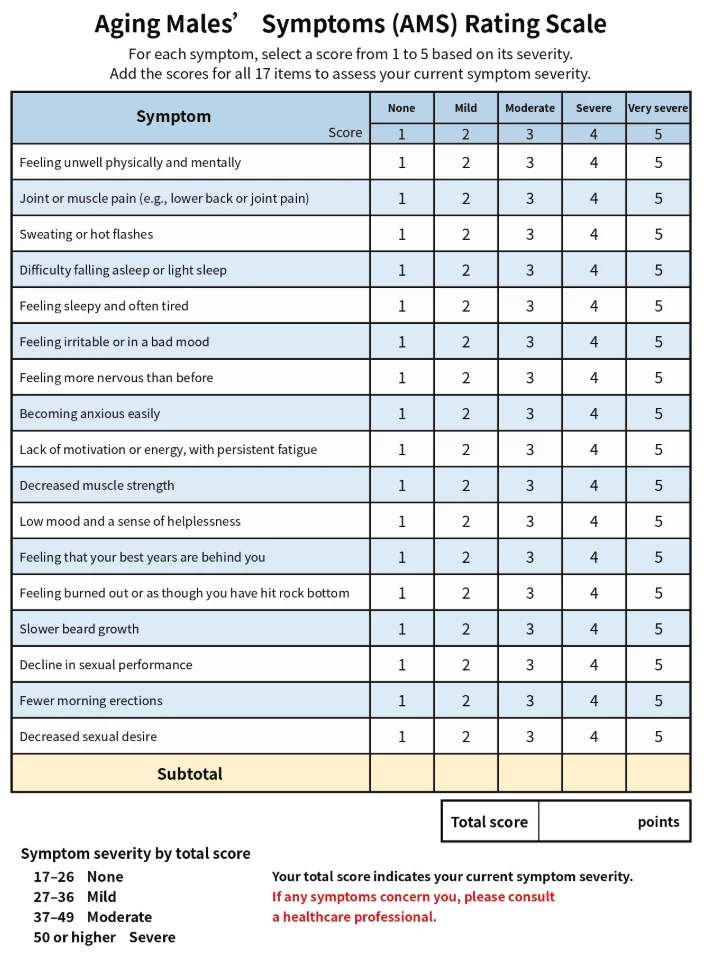
Self-Check for Menopausal Symptoms
Because the symptoms of male menopause vary greatly among individuals and encompass a wide range of manifestations such as decreased energy and insomnia, they can be difficult to distinguish from simple fatigue. Therefore, we provide a specific self-check list to help you confirm whether your discomfort indicates the possibility of male menopause:
- Persistent overall fatigue or lethargy
- Decreased enthusiasm for hobbies or activities you used to enjoy
- Becoming easily irritated over trivial matters
- Sleep disturbances and inability to wake up feeling refreshed in the morning
- Increased frequency of feeling decreased muscle strength or joint pain
- Concerns regarding sexual function or a decline in energy
If multiple items above apply to you, we recommend undergoing testing at a specialized institution rather than dismissing them through self-judgment.
For more details on states where fatigue cannot be relieved, please refer to "Why Am I So Tired? Quick Self-Check & Real Causes."
Differences from "Depression" to Watch Out For and the Importance of Accurate Differential Diagnosis
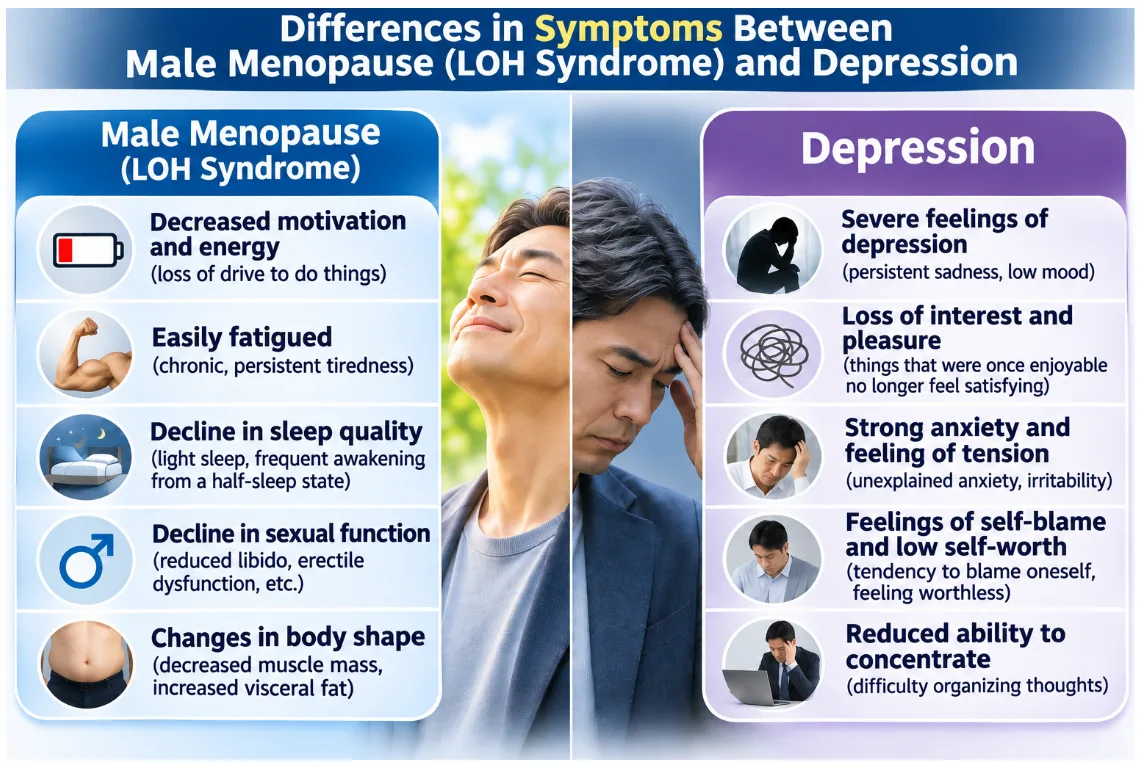
When faced with the early symptoms of male menopause—such as decreased energy, insomnia, and severe fatigue—many patients think, "Could this be a psychological issue?" and tend to visit a psychosomatic medicine clinic or psychiatric department. Here, it is crucial to pay attention to differentiating it from depression.
If specialized hormone testing is not performed, there are many cases where patients are diagnosed with "depression" at a psychosomatic medicine clinic based solely on outward symptoms and are prescribed antidepressants or anti-anxiety medications (tranquilizers) for ongoing treatment. If the primary cause of the discomfort lies in declining testosterone levels, continuing to take antidepressants that act on the central nervous system will not only fail to bring about fundamental improvement, but also carries the risk of prolonged, aimless medication use.
When experiencing mental lows or a drop in motivation in your 50s, 60s, or beyond, rather than assuming a single psychiatric disorder from the outset, taking into consideration the "possibility of hormone decline associated with male menopause" and measuring testosterone levels via a blood test is the shortcut to choosing the right treatment. Additionally, even if blood test results show testosterone levels remain within the standard reference range, testosterone replacement therapy may still be indicated in some cases. At the same time, many reports show that various symptoms can be alleviated by adjusting sleep habits, improving diet, and engaging in moderate exercise.
Which Department Should You Visit for Male Menopause? Healthcare System Challenges Hindering Early Diagnosis
Consultations for male menopause are typically handled by "Urology" departments or "Men's Health Clinics." However, when patients consider seeking medical attention, they often feel uncertain due to the following healthcare system challenges:
- Difficulty of Specialized Differential Diagnosis: Accurately determining whether a patient's reported symptoms are caused by an organic psychiatric disorder, autonomic nervous system imbalance, or hormone decline requires specialized endocrinological knowledge and clinical experience. General neighborhood clinics may not have a comprehensive system in place to handle this.
- Limitations of Insurance Coverage: Under Japan's public health insurance system, the eligibility criteria for hormone therapy and related treatments for male menopause are extremely narrow and restricted, meaning this field is predominantly practiced as self-pay (private) medical care.
- Time Lag for Test Results: In many medical institutions, because blood samples collected for testing must be outsourced to external laboratories, it often takes anywhere from several days to about a week to receive measurement results for items such as free testosterone. For patients suffering from distressing symptoms, a waiting period between the initial consultation and the start of treatment is undeniably a significant burden.
Tokyo Relife Clinic's "Same-Day In-House Testing" System
To reduce the burden on patients and allow them to transition quickly to the treatment phase, Tokyo Relife Clinic has introduced a rapid in-house hormone measurement system. Because testosterone levels can be determined shortly after blood collection, a treatment plan can be decided and implemented on the very same day of the consultation, based on a comprehensive diagnosis by a physician.
Types and Characteristics of Testosterone Replacement Therapy
When blood tests confirm a significant drop in testosterone levels that aligns with clinical symptoms, "Testosterone Replacement Therapy (TRT)" is the standard treatment option. Currently, there are three primary administration methods used clinically: "oral medications," "injections," and "topical medications (ointments/sprays)."
| Administration Form | Characteristics & Advantages | Precautions & Disadvantages |
|---|---|---|
| Oral Medications | Convenient to take. | High metabolic burden when passing through the liver, easily causing liver dysfunction. |
| Injections | Administered periodically via intramuscular injection at a medical institution, etc. | In addition to concerns regarding liver burden, the blood concentration half-life is short; levels spike sharply immediately after administration and then drop rapidly, easily causing fluctuations in efficacy. |
| Topical Medications (Gels/Ointments) | Gently absorbed through the skin (transdermal), making it easy to maintain stable blood concentrations. Currently the mainstream treatment. | Requires daily application. Caution is needed to prevent accidental transfer of the medication to family members through contact. |
Kampo (Traditional Herbal Medicine) Therapy to Alleviate Irritability and Other Symptoms
In the treatment of male menopause, in addition to hormone replacement therapy, Kampo medicine (traditional herbal medicine) is sometimes chosen for conditioning. Particularly when the drop in testosterone levels is not very pronounced, but symptoms such as irritability, decreased energy, and sweating are prominent, Kampo medicine serves as an effective option.
For example, Hochuekkito is used to replenish energy and relieve fatigue, while Saikokaryukotsuboreito is prescribed to improve mental anxiety and insomnia. Additionally, Hachimijiogan is sometimes selected for symptoms such as frequent urination or lower back pain.
Because Kampo medicine acts gently while regulating the body's balance, it is well-suited for individuals who wish to alleviate symptoms while minimizing the risk of side effects.
Precautions for Younger Generations and the New Option of "Exosome & Stem Cell Therapy"
While testosterone replacement therapy is an excellent treatment method, the same approach is not suitable for all age groups or all pathological conditions.
Risks of Exogenous Replacement for Relatively Younger Generations Under 40
For younger individuals (such as those under 40) whose testicular function is still sufficient and who are capable of secreting testosterone on their own, easily injecting or supplementing hormones externally will trigger the body's feedback mechanism, causing the brain to mistakenly believe that "there are already enough hormones in the body." As a result, the testes' natural hormone production and sperm formation functions are suppressed, carrying the risk that the body may become unable to secrete hormones on its own once administration is stopped.
Therefore, for younger individuals or those whose hormone levels are within the normal range, direct supplementation of exogenous hormones is not recommended; treatment strategies that activate the body's own secretory functions are advised.
Treatment Approaches Using Exosomes, Stem Cell Conditioned Media, and Stem Cells
If one wishes to avoid direct hormone administration, or if general malaise and declining male sexual function persist despite normal testosterone levels, therapies utilizing "exosomes" and "stem cell conditioned media"—which have garnered significant attention in the field of regenerative medicine—become viable new options.
- Mechanism of Action: Stem cell conditioned media is rich in various growth factors, anti-inflammatory cytokines, and exosomes, which act as intercellular messengers. Rather than directly supplementing hormones, they work by promoting tissue repair, microvascular regeneration, and improved blood circulation, while simultaneously aiming to condition the internal environment for hormone production.
- Local Administration for ED (Declining Male Sexual Function): One of the primary causes of age-related ED is arteriosclerosis and deteriorated blood flow in the corpus cavernosum of the penis. Treatment protocols involving the direct local injection of exosomes, etc., into the corpus cavernosum (or intramuscular/subcutaneous administration) to promote vascular endothelial regeneration and improve blood flow are advancing. Unlike the fast-acting, temporary effects of vasodilators, this is a treatment method that pursues gentle and lasting changes by improving the tissue environment.
Just as "hormone replacement therapy" is suited for those in their 60s and beyond whose hormone secretion itself has been depleted, while "exosome and stem cell therapy" is suited for those whose secretory capacity remains intact or who prioritize the restoration of vascular function, differentiating treatment methods according to age and medical condition is crucial.
For details on the differences between these treatments, please refer to "Differences Between Stem Cell Conditioned Media and Exosomes."
For stem cell therapy for menopausal disorders, please see "Menopause & Andropause."
[Self-Pay Medical Care] Side Effects, Risks, and Safety Management Associated with Treatment
To safely conduct testosterone replacement therapy and stem cell-related treatments, fully understanding potential risks and performing regular check-ups and management are indispensable.
Prostate Disorders and Elevated PSA Levels
Testosterone supplementation may worsen symptoms of benign prostatic hyperplasia (BPH) or cause an elevation in "PSA levels," a prostate tumor marker. Although a direct causal relationship with carcinogenesis itself remains debated, regular prostate examinations and PSA blood tests before and during treatment are mandatory to ensure safety.
Erythrocytosis (Polycythemia)
Because testosterone stimulates hematopoiesis (red blood cell production), excessive administration to individuals with originally normal hormone levels or continuous use of high doses can lead to abnormal proliferation of red blood cells, increasing blood viscosity and raising the risk of thrombosis and other complications. Treatment must be carried out based on clinical guidelines and after an appropriate assessment of medical indication.
Excessive Mental Excitation
If used by individuals who do not meet the eligibility criteria or by younger generations, there is a concern about the risk of excessive mental euphoria, increased aggression, or impulsivity.
Local Muscle Tightness and Neck/Shoulder Stiffness
There have been reports of temporary local muscle tension or discomfort resembling neck and shoulder stiffness occurring around the area where topical medications are applied.
*The manifestation of the above risks and side effects varies among individuals. Eligibility for treatment is determined based on a physician's examination and preliminary test results.
Summary: To Reclaim Vibrant Days
In today's longevity society, accurately understanding the state of male hormones and managing them appropriately holds immense significance for leading an active and healthy life throughout middle age and beyond.
If you are troubled by discomforts such as "feeling like fatigue just won't go away," "lacking motivation," or "seeing no improvement despite visiting a psychosomatic medicine clinic," we recommend not bearing it alone or relying on self-diagnosis, but first undergoing specialized hormone testing. Through its rapid in-house testing system, Tokyo Relife Clinic has established a same-day diagnosis framework to offer optimal treatment options tailored to each patient's age, living environment, and hormonal balance. To maintain physical and mental health as well as daily vitality, please feel free to consult with us if you have any concerning symptoms.

Medical Reviewer:Dr. Kensei Tsuzaka
His expertise encompasses autoimmune diseases, inflammation control, and integrative care for systemic disorders. He is a Board-Certified Internist (Japanese Society of Internal Medicine) and a Board-Certified Rheumatologist (Japan College of Rheumatology), and a member of the Japanese Society of Internal Medicine, the Japan College of Rheumatology, and the American College of Rheumatology. Since 2026, he has served at Tokyo Relife Clinic, where he integrates regenerative medicine with internal medicine to deliver comprehensive patient care.
TEAMS
Disclosures Regarding Self-Pay Medical Care and Unapproved Pharmaceuticals
- Type of Medical Care: The testosterone replacement therapy and exosome/stem cell therapies described in this article are self-pay (private) medical treatments not covered by public health insurance.
- Standard Fees (Tax Included): Testosterone blood test: 11,000 yen / Exosome / Conditioned Media Therapy Price List
*Specific fees vary depending on prescription dosage, number of administrations, and treatment protocols. - Main Risks & Side Effects: Induction of benign prostatic hyperplasia symptoms, elevated PSA levels, polycythemia, liver dysfunction (with oral/injectable forms), dermatitis or muscle tension at the application site, allergic reactions, etc.
- Disclosure Regarding Unapproved Pharmaceuticals, etc.: Some of the topical testosterone preparations and exosome-related preparations used in this treatment are unapproved pharmaceuticals, etc., that have not obtained domestic approval under Japan's Pharmaceuticals and Medical Devices Act. Our clinic imports and introduces these under an appropriate management system under the responsibility of our physicians. Approved pharmaceuticals with equivalent efficacy may exist domestically in Japan. While no serious safety risks have been confirmed at this time, please consult your attending physician during your consultation if you have any questions.