~Proactive care for muscle loss and age-related infirmity~
Frailty and sarcopenia are often dismissed as a "natural" part of aging. However, cellular-level changes can progress long before you notice them. Early action is crucial to protect your future health.
Conditions We Treat

・You feel tired more easily than before
・You notice muscle weakness or muscle loss and are worried about sarcopenia
・You want to actively adopt a healthier lifestyle
・You wish to maintain independent daily living as long as possible
・You feel uneasy about age‑related physical changes
・You would like regular check‑ups of your physical condition
・Beyond lifestyle changes, you are interested in more specialized health management and anti‑aging options
Many people seek consultation before symptoms become obvious.
Our core concept is early intervention before clear infirmity develops.
What Is Frailty?
Frailty is a state between "healthy" and "requiring nursing care," where both physical and mental functions gradually decline with age. It is not a disease itself, but if frailty and muscle weakness progress, functional decline may accelerate.
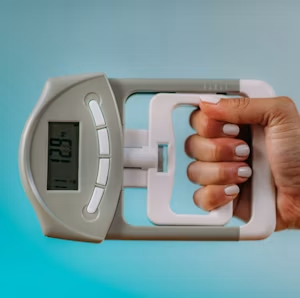
Typical evaluation items include:
・Unintentional weight loss
・Increased fatigue
・Decreased muscle strength (often linked to sarcopenia / muscle loss)
・Slower walking speed
・Reduced physical activity
Assessment also covers psychological and social changes such as:
・Reduced motivation
・Fewer opportunities to go out or interact socially
When multiple items apply, frailty is suspected. ※1
These changes often begin before they are clearly felt. Identifying your condition early and starting frailty / muscle weakness treatment and prevention is essential for long‑term health.
Main Causes of Frailty
Frailty and Sarcopenia are thought to be driven by three core mechanisms — also key targets of current anti‑aging and regenerative medicine research:
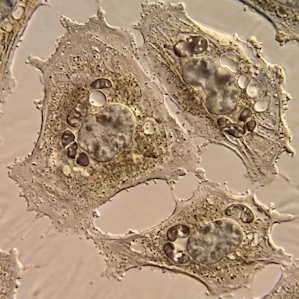
Chronic Inflammation
With aging, a low‑grade chronic inflammation can persist without obvious symptoms. Studies suggest this may impair muscle and organ function. ※2
Accumulation of Senescent Cells
Non‑dividing senescent cells build up with age and release inflammatory factors, disturbing the internal environment and contributing to frailty and muscle weakness. ※3
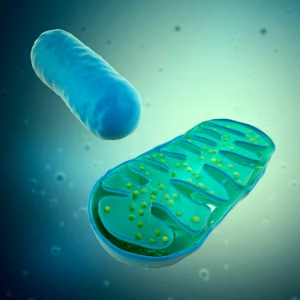
Mitochondrial Dysfunction
Mitochondria generate energy inside the cell. Their function declines with age, leading to easy fatigue and reduced activity — a key factor in infirmity and an important target for frailty treatment. ※4
Because these processes begin well before clear symptoms, understanding your internal condition early and planning anti‑aging / frailty countermeasures is critically important.
Progression of Frailty (Sarcopenia)

Frailty is thought to progress in stages from healthy → pre‑frailty → frailty → care‑dependent state. ※1
In the pre‑frailty stage, daily life is usually unaffected and symptoms are subtle, but muscle strength and metabolism may already be declining. Without any anti‑aging or muscle weakness treatment, ongoing muscle loss and reduced activity can gradually lead to overt frailty. ※1
Early Prevention Is Critical
Changes that lead to frailty often begin before symptoms appear. Chronic inflammation and age‑related cellular dysfunction quietly progress with aging. ※2
If you start to feel easily fatigued or notice muscle weakness, multiple underlying factors may already be overlapping.
For this reason, frailty management should ideally begin in the "pre‑disease" stage, before clear symptoms, with early anti‑aging intervention. ※1
- Understand your physical condition early
- Adjust lifestyle habits to protect muscle strength and function
- Seek professional anti‑aging health management when needed
These steps may help reduce future risk of sarcopenia and age‑related functional decline, supporting healthier aging over the long term.
Conventional Approaches vs. Tokyo Relife"s Concept
Traditionally, frailty management focuses on: ※1
- Regular exercise
- Adequate nutrition
- Social participation
These lifestyle measures remain the essential foundation of prevention.
However, recent research emphasizes cell‑level changes behind frailty and infirmity, such as: ※2–4
- Chronic inflammation
- Accumulation of senescent cells
- Mitochondrial decline
At Tokyo Relife Clinic, we believe it is crucial to understand internal changes at an early stage. We therefore use tests based on epigenetic changes to assess biological aging and provide personalized health management plans as part of anti‑aging care.
Rather than waiting for clear symptoms and advanced muscle weakness to appear, we encourage proactive choices when early signs first emerge. Early intervention for frailty and sarcopenia is a key direction for maintaining function and independence over time.
Our Cellular Approach to Frailty and Sarcopenia
At Tokyo Relife Clinic, we focus on the cellular changes underlying frailty, sarcopenia, muscle loss, and muscle weakness. We offer a range of regenerative and anti‑aging options—including stem cell therapy, NK cell therapy, exosome infusion, and NAD+ infusion—selected individually to help support and regulate the internal environment.
1. Stem Cell Infusion
Stem cells secrete various bioactive factors. Research suggests these may have a beneficial effect on the internal environment, particularly in states of chronic inflammation, helping to rebalance the inflammatory milieu.
Recent clinical studies indicate that stem cell therapy may have potential as a new approach for preventing frailty and sarcopenia. ※5
2. Exosome Infusion
Exosomes are signaling particles released by stem cells and are thought to play a role in cell‑to‑cell communication. This therapy uses secreted components rather than the stem cells themselves.
Because it does not require cell harvesting or surgery, exosome therapy is widely used in anti‑aging care as an accessible "entry‑level" option for experiencing stem‑cell–derived effects.
3. NK Cell Therapy
NK cells are key immune cells that can recognize and attack abnormal cells. Recent research suggests a close relationship between NK cells and senescent (aging) cells, and NK cell therapy is attracting attention as a potential intervention for senescent cell accumulation. ※6
4. NAD+ Infusion Therapy
NAD+ is an essential coenzyme for mitochondrial energy production and is known to decline with age. Studies indicate that NAD+ may support the activity of longevity‑related sirtuin genes and help counter age‑related mitochondrial decline, potentially contributing to maintenance of cellular function. ※7
All of these options address changes at the cellular level. When combined with conventional lifestyle measures—exercise, nutrition, and daily habits—they may contribute to more comprehensive health management.
Treatment Expectations and Current Limitations
Our frailty‑related treatments (stem cell therapy, exosome therapy, NK cell therapy, NAD+ infusion) are next‑generation approaches that aim to improve chronic inflammatory status and support energy metabolism at the cellular level.
At the same time, these are still emerging medical fields under active research.
- Treatment effects and how they are perceived vary from person to person.
- We cannot guarantee the same results for all patients.
These therapies are positioned as support for improving the internal environment. For better outcomes, they must be combined with fundamental frailty prevention—regular physical activity, muscle training, and appropriate nutritional management—rather than used in place of these basic measures.
参考文献
※1 Fried LP, et al. J Gerontol A Biol Sci Med Sci. 2001;56(3):M146-156.
※2 Ferrucci L, et al. Nat Rev Cardiol. 2018.
※3 Childs BG, et al. Nat Rev Drug Discov. 2017.
※4 Sun N, et al. Mol Cell. 2016.
※5 Ruiz JG, et al. Cell Stem Cell. 2026;33(3):393-404.
※6 Mahindran E, et al. Int J Mol Sci. 2023;24(9):7833.
※7 Bai Z, et al. Cell Death Dis. 2022;13(4).
※8 Fang EF, et al. Trends Mol Med. 2017.