What Is NAD+ Infusion?
Who May Consider NAD+ Infusion?
What Is NAD+?
Mechanism of NAD+ Infusion
NAD+ Infusion vs. NMN
Comparison with Stem Cell Therapy
Typical Treatment Intervals
Features of Tokyo Relife Clinic
Treatment Flow
Side Effects and Complications
Contraindications
Pricing
FAQ
Important Notice: Unapproved NAD+ Infusion
What Is NAD+ Infusion?
"Why am I always tired?" "Why do I still feel tired after eight hours of sleep?"
These symptoms may be related to a lack of cellular energy. NAD+(Nicotinamide Adenine Dinucleotide) is an essential coenzyme involved in the process by which cells convert nutrients into usable energy (ATP) to support normal cellular function. Natural NAD+ levels gradually decline with age and ongoing physical or mental stress.
You may already know NMN (nicotinamide mononucleotide), a popular dietary supplement. NMN is a precursor to NAD+ and is converted into NAD+ in the body.
NAD+ Infusion, also known as NAD+ IV Therapy, delivers NAD+ directly into the bloodstream. It is intended to support cellular energy metabolism and may be considered for individuals seeking support for fatigue, physical function, and healthy aging.
Who May Consider NAD+ Infusion?
NAD+ Infusion may be considered by individuals who:

・Still feel tired even after a full night"s sleep
・Experience daytime sluggishness or low energy
・Struggle to recover after exercise
・Have difficulty falling asleep or staying asleep
・Wake up feeling unrefreshed
・Notice a decline in concentration or experience "brain fog"
・Find it easier to gain weight due to a slower metabolism
・Are concerned about skin dullness, sagging, or loss of firmness
・Feel an age-related decline in overall vitality and stamina
・Seek a more advanced approach to healthy aging
What Is NAD+?
NAD+ is a vital coenzyme found naturally in every cell of the body. It is believed to play a critical role in several key biological processes, including:
- Energy metabolism: Helping convert food into ATP, the body"s primary source of cellular energy.
- DNA repair: Supporting normal DNA repair processes.
- Mitochondrial Function: Supporting healthy mitochondrial function.
- Sirtuin Activation: Supporting the activity of a family of proteins involved in various cellular functions.
NAD exists in two forms: the oxidized form (NAD+) and the reduced form (NADH). Inside cells, these two forms continuously cycle to support normal metabolic processes.
What Are Sirtuins?
Sirtuins (SIRT1--SIRT7) are a family of proteins that have been widely studied for their roles in energy metabolism, cellular stress response, DNA repair, and other important biological processes. Sirtuins require NAD+ as a coenzyme to function properly. Maintaining adequate NAD+ levels is believed to support normal sirtuin activity.
Mechanism of NAD+ Infusion
Age-Related Decline in NAD+ Levels
While NAD+ is naturally synthesized within the body, its levels are known to gradually decline with age. This decline is believed to be related to two main factors:

・Decreased Synthesis: The activity of enzymes involved in NAD+ production, such as NAMPT, decreases with age.
・Increased Consumption: Age-related changes and chronic inflammation cause DNA damage, and repairing this damage rapidly depletes cellular NAD+. At the same time, the activity of CD38, an enzyme that breaks down NAD+, may increase with age.
Together, increased NAD+ consumption and degradation may contribute to a decline in overall NAD+ levels in the body.
What Happens When NAD+ Levels Decline?
A decline in NAD+ levels is associated with reduced energy production efficiency within the mitochondria (the cell"s "powerhouses"). Additionally, lower NAD+ levels can slow down DNA repair processes and contribute to the age-related deterioration of muscle and tissue function.
How NAD+ Infusion Works
NAD+ Infusion involves administering NAD+ directly into the bloodstream through an intravenous drip. While oral supplementation may have limitations related to absorption, intravenous administration of NAD+ has been reported to increase blood NAD+ levels following infusion [1].
By increasing blood NAD+ levels, NAD+ Infusion may support the replenishment of cellular NAD+, which may help maintain mitochondrial function and support metabolic pathways involving sirtuins.
NAD+ Infusion vs. NMN: Understanding the Differences
NMN as a Precursor to NAD+
NMN has gained considerable attention as a dietary supplement and is a precursor that is converted into NAD+ in the body. However, NMN itself is simply a precursor—meaning it must first be converted into NAD+ through metabolic pathways inside the body before it can be used.
Once converted, this newly formed NAD+ functions as a vital coenzyme within your cells.
Comparison of Replenishment Methods
There are three main approaches to supporting NAD+ levels.
Method | Route | Absorption Characteristics | Onset of Effects |
|---|---|---|---|
Diet | Oral (internal synthesis) | Moderate | Gradual |
NMN Supplement | Oral (precursor) | Varies by individual | Moderate |
NAD+ Infusion | Intravenous administration (direct delivery) | High (bypasses digestion) | More Immediate |
While diet is fundamental, it is difficult to compensate for age-related NAD+ decline through food alone. NMN supplements are convenient for daily use, though their absorption rates can vary. NAD+ Infusion bypasses the digestive tract and delivers NAD+ through intravenous administration, which has been reported to increase blood NAD+ levels.
Our Clinic"s NAD+ & NMN Supplement Set
To provide seamless and highly efficient support by combining professional clinic care with daily home care, we also offer the following set menu:
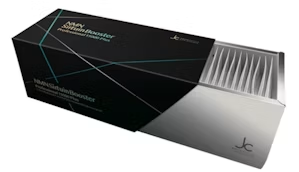
・NAD+ Infusion: Regular visits to our clinic to replenish blood NAD+ levels through intravenous administration.
・NMN Supplement: Daily oral intake to support NAD+ replenishment as a precursor.
This combined approach harnesses both immediate intravenous delivery and sustained daily support for optimal healthy aging.
Comparison with Stem Cell Therapy
We often receive questions from people considering NAD+ Infusion about how it differs from stem cell therapy. While both are considered approaches in the field of age management and healthy aging, they differ in their mechanisms, duration of effects, legal status, and level of invasiveness.
Differences Between NAD+ Infusion and Stem Cell Therapy
Category | NAD+ Infusion | Stem Cell Therapy |
|---|---|---|
Treatment | Supplementation of NAD+, a cellular coenzyme | Administration of autologous mesenchymal stem cells derived from the patient"s own adipose tissue |
Method | Intravenous infusion (60 to 90 minutes) | Infusion or local injection |
Invasiveness | Relatively low | Requires minor surgery under local anesthesia to harvest adipose tissue |
Frequency | Periodic clinic visits (often combined with supplements) | Single to a few administrations |
Typical Treatment Intervals for NAD+ Infusion
Treatment frequency varies depending on individual goals and physical condition. General guidelines are as follows:
Initial Phase: Once-weekly administration for a short period to increase NAD+ levels.
Maintenance Phase: Transitioning to maintenance sessions once or twice a month.
The final treatment frequency will be individually determined by a physician based on treatment goals, medical history, current medications, and visit availability.
Duration of Effects from NAD+ Infusion
Following NAD+ Infusion, blood NAD+ levels rise within a short period and are believed to gradually decline over the following days to weeks.
The timing of perceived benefits and their duration vary by individual and are influenced by factors such as age, lifestyle habits, medical history, nutritional status, and baseline NAD+ levels. A single session does not guarantee noticeable effects.
For those who wish to maintain perceived benefits over time, regular follow-up treatments are commonly performed.
Features of Tokyo Relife Clinic
As a regenerative medicine clinic, we provide NAD+ Infusion based on our knowledge and experience in cellular medicine.
- Commitment to Quality: The NAD+ we use is carefully selected based on purity and meets strict manufacturing and quality control standards, including those used in countries such as the United States.
- Complementary Approach: We offer a unique plan that combines direct NAD+ replenishment through NAD+ Infusion with daily precursor supplementation through NMN supplements.
- Comprehensive Age-Management Care: Beyond nutritional supplementation, we provide personalized age-management approaches based on individual needs and physical condition, including combination approaches with stem cell therapy and exosome therapy (utilizing signaling molecules derived from cells).
Treatment Flow

1. Medical Questionnaire & Consultation (Approx. 10 minutes)
We will review your current symptoms, concerns, and medical history.

2. Physician Consultation & Informed Consent (Approx. 20 minutes)
The physician will conduct a medical examination and explain whether NAD+ Infusion is appropriate for you, as well as the treatment procedure. If you decide to proceed, you will be asked to sign an informed consent form.
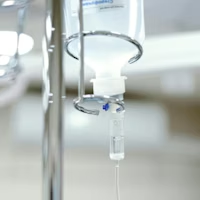
3. NAD+ Infusion (Approx. 60--90 minutes)
The NAD+ Infusion will be administered while you relax in a reclining chair. The treatment typically takes approximately 60 to 90 minutes, depending on the dosage.
Please note: During the infusion, rare symptoms such as palpitations, flushing, or mild discomfort may occur. If you experience any of these symptoms, please inform a member of our staff immediately.
Side Effects and Complications of NAD+ Infusion
The following side effects and complications may occur with this treatment:
- Pain, redness, swelling, bruising, or minor puncture marks at the infusion site: These typically resolve within a few days.
- Pain along the vein or a sensation of warmth
- Nausea, dizziness, palpitations, or headache
- Allergic reactions (such as rash or itching)
- Other unexpected physical symptoms
Note: If you experience any symptoms, please notify our medical staff immediately and follow the physician"s instructions.
Contraindications for NAD+ Infusion
You may not be eligible for this treatment if you:
- Are under 18 years of age
- Are pregnant, breastfeeding, or may be pregnant
- Have a known hypersensitivity to any of the ingredients
- Are deemed medically unsuitable by our physicians
PRICE
InfusionNAD+ Therapy
InfusionNMN Therapy
SupplementNMN
Booster SetNAD+&NMN Supplement Set
FAQ
- Q:How often should I receive NAD+ treatment?A:
Generally, we recommend an initial phase of once-weekly administration for a short period to help increase NAD+ levels, followed by maintenance sessions once or twice a month. The optimal frequency varies depending on age, goals, physical condition, and lifestyle. Our physician will provide an individualized recommendation during your consultation.
- Q:What are the potential side effects of NAD+ treatment?A:
Serious side effects are extremely rare. However, during the infusion some patients may experience mild, temporary reactions such as chest tightness, palpitations, a feeling of warmth, or a mild headache.
You might also experience temporary redness or pain at the injection site. Research [3] notes that occasional mild side effects are generally limited to nausea, fatigue, sleep changes, or transient elevations in liver enzymes. If you feel any discomfort during or after treatment, please notify our staff immediately.
- Q:Can NAD+ Infusion help support sarcopenia prevention?A:
Yes, it may offer valuable support. NAD+ plays a crucial role in mitochondrial energy production, and its age-related decline is linked to the progression of sarcopenia and muscle loss. In a recent trial, elderly participants taking NMN (an NAD+ precursor) for 12 weeks showed increased blood NAD+ levels, along with improved walking speed and sleep quality [2]. However, preventing sarcopenia requires a comprehensive approach. While proper nutrition and exercise remain foundational, NAD+ infusion can be a powerful supplementary tool in your healthy aging strategy.
- Q:Is it beneficial to combine NAD+ Infusion with NMN supplements?A:
NAD+ Infusion provides direct replenishment, while NMN supplements provide precursor replenishment. These two approaches involve different absorption routes and timings of action. To combine these two approaches complementarily, our clinic offers the NAD+ & NMN Supplement Set.
Note: Combining these methods does not guarantee greater benefits. Our physician will recommend an individualized treatment plan based on your preferences. - Q:What is the benefit of the infusion compared to taking NMN supplements alone?A:
The main difference lies in absorption and efficiency. NAD+ Infusion is administered intravenously, bypassing the digestive tract, and has been reported to efficiently elevate blood NAD+ levels [1]. On the other hand, NMN supplements are taken orally, their metabolism in the digestive tract and absorption rates may vary by individual.
Important Notice: Unapproved NAD+ Infusion (Self-Pay Treatment)
Our NAD+ infusion therapy is a self-pay treatment (not covered by insurance) that uses a product not approved under Japan"s Pharmaceuticals and Medical Devices Act (PMD Act / Yakki-Ho).
In accordance with Japanese regulations on unapproved medical products, we disclose the following:
Unapproved Status in Japan
This NAD+ product has not been approved in Japan as a pharmaceutical under the PMD Act.
Procurement Route
Under the judgment and responsibility of our physicians, the product is imported directly from the United States as a personal import for medical use.
Under Japanese law, it is legally permissible for a licensed physician to import such a product and administer it within a medical practice.
Availability of Equivalent Approved Products in Japan
At present, no domestically approved pharmaceutical products exist in Japan that contain the same active ingredient at the same concentration or have an equivalent formulation and performance to this NAD+ preparation.
International Safety Information
While NAD+ is distributed in the United States and other countries as a dietary supplement, sufficient data regarding its approval status as a pharmaceutical drug or serious adverse effects has not yet been fully established.
Currently reported side effects include: temporary headache, nausea, and flushing.
Not Covered by Japan"s Adverse Drug Reaction Relief System
Because this NAD+ infusion uses an unapproved product, it is not eligible for Japan"s official Relief System for Sufferers from Adverse Drug Reactions.
In the unlikely event that a serious adverse reaction occurs, you will not be able to receive public compensation or relief through this system.
Please make sure you fully understand this point before deciding to undergo treatment, and discuss any questions with your physician.
References
※1 Grant R, et al. Front Aging Neurosci. 2019;11:257.
※2 Morifuji M, et al. GeroScience. 2024;46(5):4671-4688.
※3 Gindri IM, et al. Am J Physiol Endocrinol Metab. 2024;326(4):E417-E427.