
Points
Concerned About MCI? Start With a Self-Check
NCGG Dementia Self-Checklist
Is There a Self-Checklist Specifically for MCI?
Which Types of Dementia and MCI Are Easier to Identify With This Checklist?
Alzheimer’s Disease and Frontotemporal Lobar Degeneration Are Easier to Identify
What to Do If You Are Concerned About Your Results
Notice from Tokyo Relife Clinic
Key Points
- How to use the National Center for Geriatrics and Gerontology self-checklist and what to keep in mind
- The difference between symptoms that are easier to notice and those that may be overlooked
- What to do if your self-check results concern you
Concerned About MCI? Start With a Self-Check
From our 50s onward, we may begin to notice changes such as asking the same question repeatedly or having difficulty remembering someone’s name. These changes can lead to concerns about Mild Cognitive Impairment (MCI), cognitive decline, or the early signs of dementia.
If you notice changes in yourself or someone close to you, what should you do? One option is to start with a simple self-check and consult a medical professional if necessary.
The simple self-checklist developed by Japan’s National Center for Geriatrics and Gerontology (NCGG) is used by many medical institutions as a screening tool. You can use it as a first step to check for changes in yourself or a family member.
NCGG Dementia Self-Checklist
□ 1. Repeating the same things or asking the same questions
□ 2. Having difficulty remembering the names of things
□ 3. Frequently misplacing items or forgetting where things were put
□ 4. Losing previous interests or hobbies
□ 5. Becoming less careful about personal appearance or daily habits
□ 6. No longer following regular daily routines
□ 7. Becoming unsure about time or place
□ 8. Getting lost in familiar places
□ 9. Claiming that a wallet or other belongings have been stolen
□ 10. Becoming easily irritated over minor things
□ 11. Forgetting to turn off faucets or gas valves, or becoming less careful about fire safety
□ 12. Having difficulty following complex TV dramas
□ 13. Suddenly waking up and becoming agitated during the night
※Quoted from Reference 1.
According to this checklist, if three or more items apply, consultation with a healthcare professional is recommended.
Is There a Self-Checklist Specifically for MCI?
At present, there is no single MCI-specific checklist that is widely used as a standard screening tool. For this reason, checklists originally designed for dementia are often used as an initial reference.Because Mild Cognitive Impairment is an earlier and milder stage of cognitive decline, someone with MCI may have only one or two items on a dementia checklist and may not meet the suggested threshold. However, even if only a few items apply, it may be worth seeking medical advice if you or your family notice persistent memory loss, changes in thinking, or other concerns.
According to Chiken Japan (Reference 2), there is currently no single official MCI-specific checklist for the general public published or recommended as a standard tool by Japan’s Ministry of Health, Labour and Welfare or relevant medical societies.
Why Are There Few MCI-Specific Checklists?
- Many MCI symptoms overlap with those included in dementia screening tools.
- MCI is milder than dementia, and it can be difficult to predict whether it will progress to dementia.
- There are different types of MCI, making it difficult for a single checklist to identify every pattern of cognitive impairment.
Which Types of Dementia and MCI Are Easier to Identify With This Checklist?
Alzheimer’s disease is the most common cause of dementia. Among people with MCI, amnestic MCI, which primarily affects memory, is an important subtype associated with a higher risk of progression to Alzheimer’s disease. For this reason, dementia screening checklists often include several questions related to memory loss and other changes commonly associated with Alzheimer’s disease. As a result, these checklists may be more likely to identify memory-related changes, while some symptoms associated with other types of MCI or Cognitive Disorders may be less noticeable.
A self-checklist should therefore be considered a screening tool rather than a dementia test that can provide a diagnosis. A medical evaluation may be needed to determine the cause and onset of cognitive symptoms.
Cognitive Abilities Assessed by the Checklist
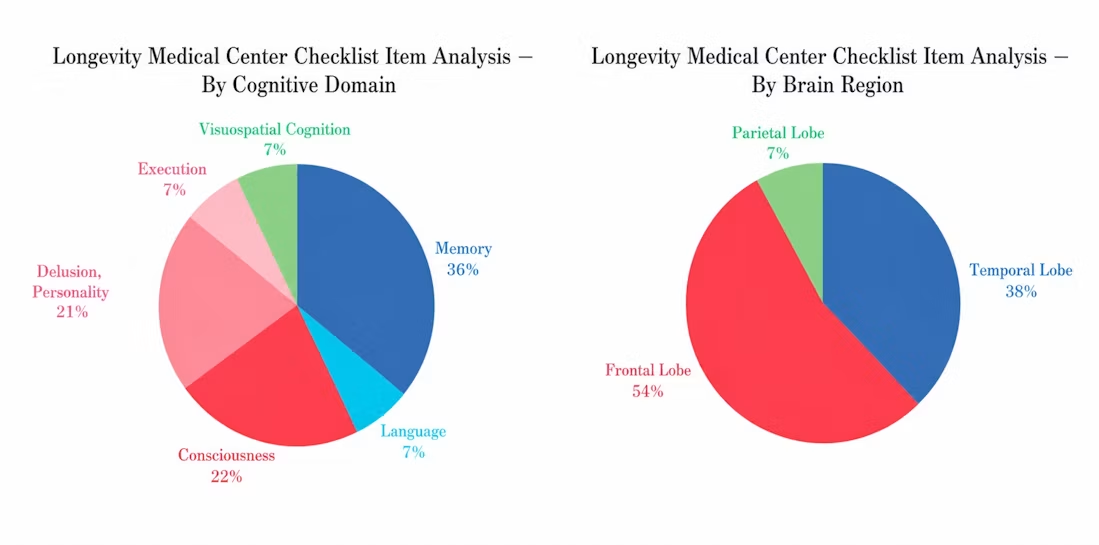
The table below is the author’s analysis of the NCGG checklist. It shows which cognitive domains—such as memory and language—are reflected in each item and the main areas of the brain associated with these cognitive functions.
NCGG Checklist Item | Cognitive Domain | Main Brain Region |
|---|---|---|
1 Repeating the same things or asking the same questions | Memory | Temporal lobe |
2 Having difficulty remembering the names of things | Language | Temporal lobe/Frontal lobe |
3 Frequently misplacing items or forgetting where things were put | Memory | Temporal lobe |
4 Losing previous interests or hobbies | Motivation | Frontal lobe |
5 Becoming less careful about personal appearance or daily habits | Motivation | Frontal lobe |
6 No longer following regular daily routines | Motivation/Other | Frontal lobe |
7 Becoming unsure about time or place | Orientation (Memory) | Temporal lobe |
8 Getting lost in familiar places | Visuospatial function | Parietal lobe |
9 Claiming that a wallet or other belongings have been stolen | Delusions | Frontal lobe |
10 Becoming easily irritated over minor things | Personality | Frontal lobe |
11 Forgetting to turn off faucets or gas valves, or becoming less careful about fire safety | Executive function / Attention | Frontal lobe |
12 Having difficulty following complex TV dramas | Memory/Language | Temporal lobe/Frontal lobe |
13 Suddenly waking up and becoming agitated during the night | Delusions | Frontal lobe |
Other: The cognitive domain affected may vary from person to person.
※Checklist items quoted from Reference 1.
The pie charts below classify the checklist items by cognitive domain and brain region and show the proportion of items in each category.
Alzheimer’s Disease and Frontotemporal Lobar Degeneration Are Easier to Identify
Looking at the colors, you will notice that blue and red account for most of the checklist items. In the chart on the left, around 80% of the items focus on memory loss (36%), motivation (22%), and personality/delusions (21%). These correspond to the same colors in the chart on the right and are mainly associated with functions of the temporal and frontal lobes.
When these cognitive domains and brain functions are linked to different types of dementia and Mild Cognitive Impairment (MCI), they can be summarized as follows.
“Blue” Type: Begins With Memory Loss
→ Alzheimer’s disease / Amnestic MCI
“Red” Type: Begins With Changes in Personality or Motivation
→ Frontotemporal lobar degeneration (FTLD) / Non-amnestic single-domain MCI
Other Types to Watch For
Other patterns may include the following:
“Light Blue” Type: Mainly Affects Language Function
→ Progressive aphasia / Non-amnestic single-domain MCI
Dementia with Lewy bodies (DLB) can be more difficult to identify. Visual hallucinations are a characteristic symptom, but at the MCI stage, mild cognitive decline may also affect other cognitive functions. Therefore, its early signs may be difficult to recognize using this checklist alone.
What to Do If You Are Concerned About Your Results
A checklist alone cannot provide a medical diagnosis. An actual diagnosis requires a comprehensive evaluation that may include physical assessments such as blood tests and brain imaging, cognitive function tests, and a review of daily activities and lifestyle.
However, a self-checklist can be a useful first step in deciding whether to seek medical advice. Many local governments in Japan also provide checklists to encourage early detection and consultation.
If your results concern you, or if you feel that “something is different” even though only a few items apply, consider undergoing a more detailed assessment by a healthcare professional. A professional evaluation or dementia test can help clarify whether symptoms such as memory loss or other changes may be related to MCI, dementia, or another condition.
【Notice from Tokyo Relife Clinic】
A New Approach to Mild Cognitive Impairment (MCI)
If any items in the self-check raised concerns, please feel free to consult us. In addition to professional assessments by a speech-language-hearing therapist and guidance on lifestyle improvements, Tokyo Relife Clinic also offers supportive approaches aimed at optimizing the cellular environment, including intranasal stem cell culture supernatant/exosome therapy and NAD+ IV therapy. Even if you are unsure whether you need medical attention, you can start by reviewing your current cognitive health with a professional.
Written and contributed by: Mie Koyama, Speech-Language-Hearing Therapist
<Professional Background>
Worked in psychological assessment at the Memory Clinic of Musashi Hospital, National Center of Neurology and Psychiatry (now the National Center of Neurology and Psychiatry). She later worked in speech-language-hearing therapy at the Department of Communication Sciences and Disorders, Prefectural University of Hiroshima; the Rehabilitation Department of Yokohama Brain and Spine Center; and long-term care health facilities.
References
※1 認知症チェックリスト第二版、愛知県健康福祉部高齢福祉課、2017年
※2 軽度認知障害(MCI)チェックリスト|初期症状のサインと「物忘れ」との違い・回復への対策まで解説 | 治験モニターのススメ、治験ジャパン、2025.12.19