
Conditions We Treat
What Is Osteoarthritis?
How Knee Osteoarthritis Progresses
Regenerative Medicine Treatment Applicability
Osteoarthritis Treatment Options: Comprehensive Comparison
Tokyo Relife Clinic's Regenerative Medicine Treatment Options
Treatment Process
Safety Considerations & Treatment Precautions
Treatment Fees
Frequently Asked Questions (FAQ)
Advanced Regenerative Medicine Using Stem Cell Injection and Autologous Cells to Target Knee Joint Pain at Its Source
"knee pain when climbing stairs", "pain in knees when standing up"
These may be early warning signs of knee osteoarthritis (medically termed degenerative joint disease). The underlying causes include secondary osteoarthritis from previous trauma or disease, and primary osteoarthritis resulting from aging, weight gain, and muscle loss—with the latter accounting for the vast majority of cases in Japan.
While surgical intervention was once the primary treatment approach, new treatments for osteoarthritis of the knee utilizing regenerative medicine with stem cell injection and PRP therapies have emerged as promising therapeutic options.
Conditions We Treat

Many patients search for answers to "why do my knees pain" or "what causes knee pain." If you experience any of the following symptoms, Tokyo Relife Clinic offers specialized osteoarthritis treatment solutions:
・Sharp knee joint pain when standing up or taking first steps
・Pain when climbing stairs or walking long distances
・Hyaluronic acid injections no longer providing relief
・Daily reliance on painkillers
・Want to avoid knee replacement surgery
・Knee pain affecting normal walking
・Desire to walk independently
For patients facing these challenges, Tokyo Relife Clinic provides osteoarthritis treatment focused on improving knee pain through the regenerative potential of your body's own cellular resources.
What Is Osteoarthritis? Understanding the Root Causes
Knee osteoarthritis can be classified into two primary categories:
- Secondary osteoarthritis: specific prior injury or underlying disease
- Primary osteoarthritis: resulting from the cumulative effects of aging and lifestyle factors.
Primary osteoarthritis represents the overwhelming majority of cases, with prevalence rising sharply from the 50s onward—affecting an estimated 25.3 million potential patients in Japan. ※1
Previously dismissed as simply "a natural part of aging," current research has identified the fundamental mechanism as a breakdown in the balance between mechanical stress on the knee joint and the body's natural repair capacity. Years of accumulated physical load cause microscopic damage to cartilage and meniscal tissue, triggering chronic inflammation within the joint cavity. This inflammatory process then accelerates cartilage degradation, creating a progressive cycle of deterioration.
At Tokyo Relife Clinic, our regenerative medicine approach using stem cell injection and PRP therapy targets this underlying chronic inflammatory environment as the foundation of effective osteoarthritis treatment.
How Knee Osteoarthritis Progresses
The severity of knee osteoarthritis is typically assessed using the Kellgren-Lawrence (KL) grading system based on radiological imaging. However, X-ray findings showing bone deformity do not always directly correlate with the internal condition of the knee joint, including cartilage integrity, meniscal damage, and degree of inflammation.
For comprehensive clinical assessment, Tokyo Relife Clinic requires patients to provide MRI imaging prior to consultation. MRI evaluation allows detailed assessment of bone structure, cartilage condition, meniscal integrity, and intra-articular inflammatory changes—providing a far more complete clinical picture than radiological imaging alone.
The relationship between internal joint changes and imaging findings typically progresses as follows:

1. Grade 0 (Normal) — Grade 1
Radiological Findings: Generally normal appearance, or mild osteophyte formation without joint space narrowing.
Internal Joint Environment:
・Accumulated mechanical load from weight gain and repetitive stress
・Declining joint stability due to muscle mass reduction
・Early microscopic cartilage changes not yet visible on imaging
2. Grade 1 — Grade 2
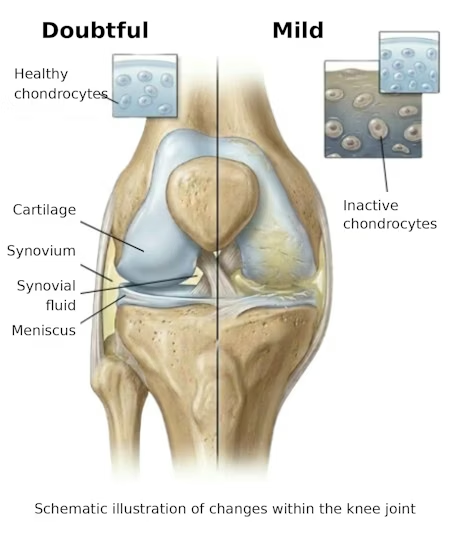
Radiological Findings: Cartilage thinning becomes apparent; early joint space narrowing develops.
・Declining chondrocyte activity associated with aging
・Progressive cartilage and meniscal degeneration due to reduced self-repair capacity
・Possible mild joint effusion and early inflammatory changes
3. Grade 2 — Grade 4
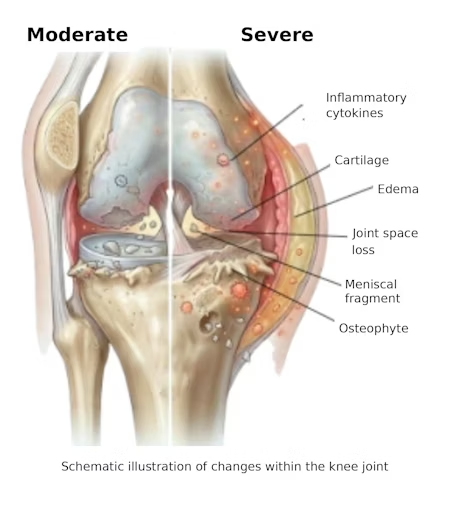
Radiological Findings: Prominent osteophytes and significant joint space narrowing; advanced stages show complete joint space loss and marked bone deformity.
・Cartilage fragments and meniscal debris accumulate within the joint cavity
・Synovial tissue identifies debris as foreign material, triggering excessive secretion of inflammatory cytokines and synovial fluid → Progressive joint effusion and visible knee swelling
・Inflammatory mediators activate cartilage-degrading enzymes
・Creating a negative spiral of escalating inflammation ※2
Regenerative Medicine Treatment Applicability
The stem cell injection, stem cell culture supernatant, and PRP injection therapies offered at Tokyo Relife Clinic are primarily indicated for KL Grade 0–3, focusing on:
・Suppression of intra-articular inflammation
・Improvement of joint microenvironment
・Delay of symptom progression
At Grade 4, where structural joint deformity is advanced, total knee replacement surgery may represent the most appropriate primary treatment option.
Important Note: Internal joint pathological changes often precede visible radiological findings. Early consultation is strongly recommended if you begin experiencing knee discomfort.
Osteoarthritis Treatment Options: Comprehensive Comparison
For patients researching "new treatments for osteoarthritis of the knee" or seeking the most effective therapeutic approach, multiple clinical options are available. The following comparison examines each modality from the perspective of treatment impact on daily life:
Treatment Approach | Regenerative Medicine | Medication | Hyaluronic Acid | Surgery |
|---|---|---|---|---|
Mechanism | Anti-inflammatory + environment restoration | Temporary pain relief | Joint lubrication | Joint replacement |
Duration | Medium to long-term | During medication only | Short-term, repeat needed | Long-term |
Downtime | Same-day discharge | None | Same-day discharge | Months (Hospitalization) |
Risks | Mild swelling/pain *Note: Cartilage cannot be fully restored to its original state. | Stomach/organ strain | Mild swelling/pain | Anesthesia risks, revision |
Best For | Grade 0–3 | Grade 1–4 | Grade 1–3 | Grade 4 |
※Treatment outcomes and duration vary among individuals across all therapeutic modalities. Tokyo Relife Clinic provides personalized treatment recommendations based on comprehensive MRI-based joint assessment and current symptom profile.
Tokyo Relife Clinic's Regenerative Medicine Treatment Options
◎Adipose-Derived Stem Cell Injection Therapy (Autologous Mesenchymal Stem Cell Treatment)
Your own adipose-derived mesenchymal stem cells are cultured and delivered directly into the knee joint via stem cell injection. This approach targets chronic inflammation to help restore the joint's microenvironment.
Clinical research & Outcomes: Recent stem cell research※3 demonstrates:
- 19.24-point drop in VAS pain scores
- Improved daily function (WOMAC scores)
- Increased cartilage volume visible on MRI
Regenerative Medicine Approval Number: PB3250003 (Autologous Adipose-Derived Stem Cell Therapy for Osteoarthritis)
→ Stem Cell Therapy Details
◎Stem Cell Culture Supernatant Therapy
Stem cell culture supernatant contains bioactive growth factors and cytokines secreted by mesenchymal stem cells, offering a non-surgical treatment option. that may provide therapeutic benefits similar to direct stem cell therapy.
Clinical research: Studies utilizing intra-articular injection of culture supernatant have reported pain reduction, functional improvement, and cartilage volume increases on MRI. As this treatment does not involve living cells, multiple treatment sessions are typically required compared to direct stem cell injection. ※4
→ Stem Cell Culture Supernatant Treatment Details
◎PRP Injection Therapy (Platelet-Rich Plasma)
PRP therapy involves extracting the patient's own blood, concentrating the platelet-rich plasma, and administering it via intra-articular injection. into the knee joint.
Clinical research: For mild knee osteoarthritis, multiple PRP injections have been reported to effectively reduce pain and restore functional capacity, though significant changes in cartilage volume have not been consistently demonstrated. ※5
Regenerative Medicine Approval Number: PB3240222 (Platelet-Rich Plasma [PRP] Injection Therapy for Osteoarthritis and Intra-articular Injury)
→ PRP Treatment Details
※Clinical data cited above are derived from small-scale studies and do not constitute a guarantee of treatment outcomes for all patients.
Treatment Process: Osteoarthritis Treatment

1. Initial Consultation & Medical Assessment (~20 min)
We review your current symptoms, treatment history, and lifestyle factors in detail.

2. Physician Examination & Treatment Planning (~30 min)
We assess your knee joint condition using MRI imaging. Please bring your MRI data to the appointment. — without it, we may need to reschedule your visit.
For patients traveling from abroad: We offer online medical consultations (Initial consultation fee: ¥11,000, payable in advance).
Based on your assessment, your physician will recommend the most suitable osteoarthritis treatment from stem cell injection, stem cell culture supernatant, or PRP injection.
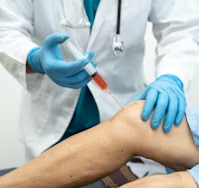
3. Treatment Administration
We inject directly into your knee joint using ultrasound guidance for accuracy and safety. Most treatments are completed the same day with no hospitalization needed.
For stem cell therapy: We collect your fat tissue on the first visit for cell culture, so the actual stem cell injection is scheduled later. You can combine other treatments during this first visit if desired.
4. Post-Treatment Monitoring
We check your knee condition after each treatment and adjust the schedule if needed. Based on your recovery, we may discuss follow-up or combination therapies.

5. Long-Term Management & Follow-Up
Knee osteoarthritis rarely improves with just one treatment. We recommend regular check-ups and ongoing care to help manage your symptoms over time.
Safety Considerations & Treatment Precautions
At Tokyo Relife Clinic, PRP, stem cell culture supernatant, and stem cell therapy each have different precautions and contraindications.
Please check the specific pages for details:
→PRP Therapy Safety Guidelines
→Stem Cell Culture Supernatant Precautions
→Stem Cell Therapy Safety Information
PRICE
Adipose-Derived Stem Cell Therapy Osteoarthritis Treatment(Knee)
PRP Osteoarthritis、Knee Joint Therapy
References:
※1 Yoshimura N, et al. J Bone Miner Metab. 2009;27(5):620-8.
※2 Tong L, et al. Bone Res. 2022;10:60.
※3 Ma W, et al. Medicine (Baltimore). 2020;99(49):e23343.
※4 Partan RU, et al. J Clin Med. 2023;12(22):7138.
※5 CChawla S, et al. Ann Med Surg (Lond). 2024;86(3):1618-1632.
※6 Lee WS, et al. Stem Cells Transl Med. 2019;8(6):504-511.
※7 Rahmadian R, et al. J Orthop Surg Res. 2025.