
Key Points
Aging and MCI
Reversible MCI
What Is the Difference Between Brain Fog and MCI?
Why Did Reversible MCI Become MCI?
Preventing Reversible MCI
Progressive MCI and Common Diseases That Cause MCI
Alzheimer"s Disease
Lewy Body Dementia
Frontotemporal Degeneration
Treatment Medications for MCI
A Message from Tokyo Relife Clinic
Key Points
- "Brain fog(often described as a "foggy" or "unclear" feeling in the head )" and MCI share similar symptoms, but their medical backgrounds differ, and brain fog tends to be more likely to improve.
- The causes of MCI vary widely. "Some" cases may be reversible or preventable, while others may be related to progressive diseases such as Alzheimer"s disease.
- There are more than ten underlying diseases that cause progressive MCI, and because each has different early signs, identifying them correctly is important.
Aging and MCI
The age group in which MCI symptoms are suspected is generally people in their 50s and older. This is also the period when natural age-related decline in physical and cognitive function may begin to appear.
Natural aging can be a basic contributing factor. When an additional cause is involved, a person may develop what is generally defined as MCI, a condition regarded as a pre-stage of dementia.
Reversible MCI
Even when someone has been judged to be "in a state of MCI," this can include cases such as "it was simply that the decline seen in healthy aging arrived a little earlier than usual," or "once an infection was treated, cognitive function improved as well." Such cases constitute "reversible MCI" (in a sense, an apparent or pseudo-MCI state). This means it can be difficult to determine without follow-up observation. If a case falls under "Reversible Dementia" in the table below and remains at the MCI stage—short of dementia—improvement can be expected.
Major Underlying Diseases That Cause Dementia
Cause | Disease name | Reversible Dementia |
|---|---|---|
Central nervous system degenerative diseases | Alzheimer"s disease, Lewy body dementia, frontotemporal dementia, corticobasal degeneration, progressive supranuclear palsy, etc. |
|
Cerebrovascular disorders | Vascular dementia (multi-infarct dementia, VaD due to a single lesion in a strategic site, small vessel disease dementia) |
|
Infections | Encephalitis, neurosyphilis | 〇 |
Tumors | Primary brain tumors, metastatic brain tumors | 〇 |
Traumatic diseases | Chronic subdural hematoma, brain contusion | 〇 |
Cerebrospinal fluid circulation disorders | Normal pressure hydrocephalus | 〇 |
Endocrine disorders | Hypothyroidism, hyperparathyroidism, etc. | 〇 |
Intoxication / Nutritional disorders | Alcohol intoxication, vitamin B12 deficiency, etc. | 〇 |
Cited from Reference ※1
What Is the Difference Between Brain Fog and MCI?
After the COVID-19 pandemic, the term "brain fog" became more commonly heard. Brain fog refers to a feeling of mental cloudiness or having "fog in the head."
It is often used to describe symptoms such as difficulty concentrating, being unable to recall things quickly, or feeling unable to think clearly after recovering from an infection. These symptoms may reflect a state in which cognitive functions, such as memory and attention, are not working smoothly, or a state in which motivation has declined.
In addition to post-COVID conditions, the term brain fog is also used in relation to chronic fatigue syndrome(CFS), depression, menopause, lack of sleep, and stress.
Complaints such as "I feel mentally foggy lately" or "I can"t remember things well" may be seen in both brain fog and MCI. However, in medical diagnosis, it is important to distinguish between the two.
In general, brain fog is considered more likely to improve than MCI. Although the causes and likelihood of improvement differ, both conditions may share a common background: a reduced level of brain activity. This is why they can lead to similar symptoms and complaints.
Why Did Reversible MCI Become MCI?
As noted in "What Is MCI?", it is said that while approximately 5–15% of people with MCI progress to dementia within one year, approximately 16–41% return to a healthy state within one year※1. These figures show that the possibility of improvement can be estimated to be considerable.
The term MCI emerged from a desire within dementia research to detect and respond at a stage even earlier than the early phase of dementia. Subsequently, following and studying people thought to have MCI revealed what appears to be the current understanding: that they are a mixed group of "those who were originally assumed to be in a pre-dementia stage caused by progressive diseases" plus "those in an MCI state for other reasons."
In other words, the latter group—"MCI not caused by progressive disease"—has a high proportion of people for whom improvement can be expected. According to the table, these people fall under infections, tumors, traumatic diseases, cerebrospinal fluid circulation disorders, endocrine disorders, intoxication, and nutritional disorders, and many of these can be prevented by maintaining good everyday health.
Preventing Reversible MCI — Let"s Improve Lifestyle Habits
People with "MCI not caused by progressive disease" can work toward prevention by improving their lifestyle habits. While a stroke (cerebrovascular disease), are difficult to fully treat once they occur, prevention is likewise possible.
In a word, it comes down to "leading a healthy life"—the commonly stated basics such as a balanced diet, moderate exercise, reducing stress as much as possible, and moderation in drinking and smoking. Improving one"s lifestyle helps prevent lifestyle-related diseases (such as hypertension and diabetes), which in turn protects the blood vessels of the heart and brain and slows the pace of aging.
Maintaining physical mobility through diet and exercise also helps prevent accidents. Falling over or falling from a height can result in hitting one"s head. This may cause head trauma or subarachnoid hemorrhage. As a result, a person may develop dementia, MCI, or higher brain dysfunction, and daily life may become difficult. In order to prevent such outcomes, paying attention to diet and exercise is also important.
Can "Insufficient Sensory Input" Also Be a Cause of MCI?
Eye and ear care is also important for improving an MCI-like condition. As people age, eye diseases such as cataracts and glaucoma may develop, making it harder to see clearly. Hearing may also decline. When this happens, the information entering from the outside world becomes unclear. As a result, the brain that processes this information may also begin to decline, making reactions and judgment less accurate. For this reason, it is desirable to keep the information coming from the eyes and ears as clear and accurate as possible, in order to support healthy brain function.
Progressive MCI and Common Diseases That Cause MCI
The causes of MCI include the diseases also mentioned in "What Is MCI?" Once a disease develops and progresses to a certain stage, the condition comes to be called dementia. However, if the disease progresses slowly, a person may remain in the MCI stage for many years and continue daily life without requiring assistance from others.
MCI Is Not Simply Forgetfulness: 10 Diseases That Can Cause MCI
According to the Clinical Practice Guidelines for Dementia 2017, created by six academic societies including the Japanese Society of Neurology, there are 10 major diseases that can lead to dementia. These are organized by chapter in the guideline and include the widely known Alzheimer"s disease(AD).
- Alzheimer"s disease
- Lewy body dementia
- Frontotemporal lobar degeneration
- Progressive supranuclear palsy
- Corticobasal degeneration
- Argyrophilic grain dementia
- Senile dementia of the neurofibrillary tangle type
- Huntington"s disease
- Vascular dementia
- Prion disease
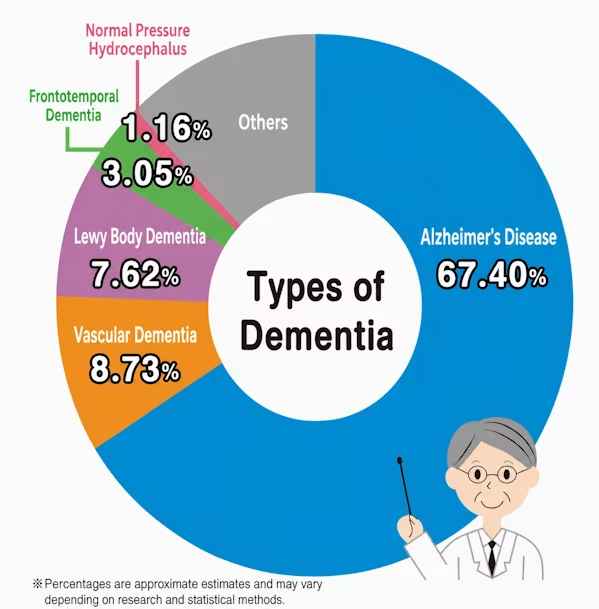
Cited from Reference ※2
In this article, we will focus on Alzheimer"s disease, Lewy body dementia (LBD), and frontotemporal degeneration (FTD). These three diseases account for a relatively high proportion of dementia cases. However, the early symptoms of each condition have different characteristics. If we focus only on the best-known condition, Alzheimer"s disease, it may become difficult to recognize the early signs of other types of dementia.
Alzheimer"s Disease(AD)— Progression from "Amnestic MCI"
One type of MCI, "amnestic MCI," is expected to progress in the future to Alzheimer"s disease (AD). Cognitive function involves many different brain processes, but a characteristic feature of amnestic MCI is that memory declines before other domains. According to a project by the U.S. National Institutes of Health(NIH), the progression rate from amnestic MCI to dementia has been reported as 16% after one year, 24% after two years, and 49% after three years※3.
In typical Alzheimer"s disease, functional decline has been reported to begin in the brain"s temporal lobe, followed by the parietal lobe and then the frontal lobe※4. The temporal lobe contains a region related to memory called the "hippocampus," and in Alzheimer"s disease, decline in hippocampal function is said to cause the condition to begin with memory impairment. Besides memory, the temporal lobe also contains regions related to language; the parietal lobe relates to visuospatial cognition; and the frontal lobe is said to relate to judgment and sociability.
In other words, the progression of Alzheimer"s disease can be explained according to the order in which the brain"s functional decline advances, following the order of brain atrophy:
- Temporal lobe – Memory loss
- Temporal lobe – Word-finding difficulty (struggling to recall words)
- Parietal lobe – Visuospatial cognition / construction (unable to dress oneself, difficulty understanding 3D shapes, etc.)
- Frontal lobe – Decline in judgment
Lewy Body Dementia — Progression from "Non-Amnestic, Multiple-Domain MCI"
In recent years, Lewy body dementia (LBD) has gradually become known as a recognized type of dementia other than Alzheimer"s disease. The pre-stage of Lewy body dementia is considered to be "non-amnestic, multi-domain MCI." At this stage, the following symptoms may appear※5:
- Visual hallucinations (reporting one sees things that are not actually there)
- Fluctuations in cognitive function (unable to do something yesterday, able to do it today)
- Parkinsonism (the motor symptoms that occur in Parkinson"s disease)
Not all of these appear at the MCI stage, and their severity is thought to be milder than at the dementia stage.
The characteristic abnormal proteins called "Lewy bodies" are not seen in the brain at the MCI stage, but appear once the condition reaches the dementia stage. In addition, at the dementia stage, abnormal behavior during REM sleep and hypersensitivity to antipsychotic drugs may also be seen.
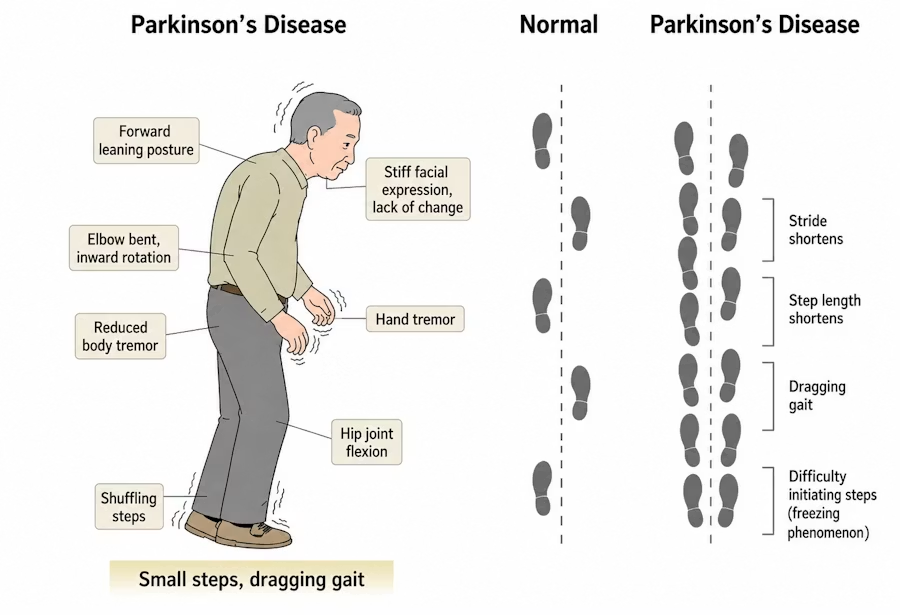
Cited from Reference ※4 — Characteristics of Movement and Gait in People with Parkinson"s Disease
At present, Parkinson"s disease and Lewy body disease are thought to arise from the same cause and to lie on a continuum. If parkinsonism (motor symptoms) appears one year or more before cognitive symptoms, the condition is classified as Parkinson"s disease. Both Parkinson"s disease and Lewy body disease are expected to result in similar states as they progress.
Visual hallucinations are thought to be caused by reduced blood flow in the brain"s occipital lobe (which handles vision-related processing)※4. If Lewy bodies are deposited in the occipital lobe, "visual hallucinations" result; if in the hypothalamus, parkinsonism occurs; and if in the region called the anterior cingulate gyrus, "autonomic symptoms" (such as body temperature control) appear.
Frontotemporal Degeneration(FTD) — Progression from "Non-Amnestic, Single-Domain MCI"
The stage preceding FTD is often "non-amnestic, single-domain MCI." As the name indicates, functional decline occurs in the frontal lobe and temporal lobe, and the symptoms that appear in daily life differ depending on where the degeneration occurs.
As shown in the figure below, FTD is clinically classified into three types, and the impression at onset differs considerably. However, the cause of the disease lies in the accumulation of a specific protein, and symptoms differ depending on where in the brain this occurs.
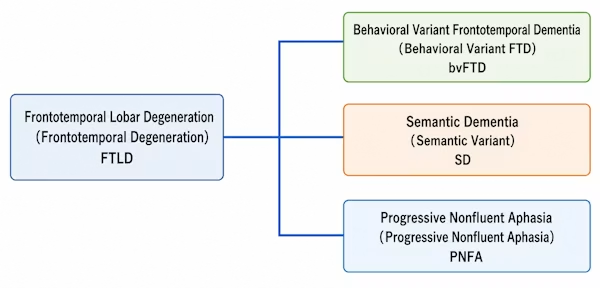
Clinical classification of FTD — Cited from Reference ※6
"Behavioral-variant frontotemporal dementia" involves functional decline centered on the prefrontal cortex, affecting personality, sociability, and judgment. As a result, the person may have conflicts with those around them or behave in ways that do not match what is generally considered common sense.
Signs during the "non-amnestic, single-domain MCI" period:
A state in which others say things to the person such as, "Lately you"ve been irritable and speak ill of others—is it age? Your expression, or your movements, seem to have become a little aggressive..."
In "semantic dementia," impairment of "semantic memory" is the most characteristic feature, with atrophy centered on the temporal lobe (the temporal pole, the middle and inferior temporal gyri). "Semantic memory" refers to general knowledge and facts, with no personal element.
Signs during the "non-amnestic, single-domain MCI" period:
Responses such as, "Sushi? Was that something I eat? It doesn"t ring a bell. Tuna on top of rice? Ah, tuna, right." The person becomes unable to recognize the appearance, taste, or origin of sushi.
"Progressive non-fluent aphasia" is a progressive state of not being able to produce words fluently, arising from atrophy of the region spanning the left frontal and temporal lobes. Unlike the aforementioned "semantic dementia," semantic information is preserved, but the words corresponding to it do not come out.
Signs during the "non-amnestic, single-domain MCI" period:
A state in which something like the following is mildly seen: "Um... what was it called? You know, the, the—yesterday we ate it together, ah, that... t-, t-, the one with tuna on top... sushi? Ah, sushi." The pronunciation may sound distorted.
Treatment Medications for MCI
As described above, MCI is positioned as a state preceding various forms of dementia. Therefore, the characteristics of the dementia that may follow are present in a very mild form. Knowing these characteristics while the condition is still mild allows more time to consider how to respond.
Recently, medications targeting MCI (Lecanemab, Donanemab) have also been approved, and those who meet the conditions can receive a prescription at outpatient clinics specializing in these drugs. If you have symptoms of concern, we recommend consulting a specialized outpatient clinic.
【A Message from Tokyo Relife Clinic】
A New Approach to MCI and Brain Fog
As explained in this article, there are many cases in which "brain inactivity" or "chronic inflammation and fatigue" are involved in the background of MCI and brain fog. In addition to guidance on improving lifestyle habits, our clinic offers brain care using "regenerative medicine (stem cell culture supernatant, exosome nasal administration, etc.)" and "NAD+ infusion therapy," which support improvement of the cellular-level environment. If you are concerned about brain fog or worried about a decline in cognitive function, please feel free to contact our clinic for an initial consultation.
Written and contributed by: Mie Koyama, Speech-Language-Hearing Therapist
Speech-Language-Hearing Therapist (ST)
Formerly conducted psychological assessment and cognitive testing at the Memory Clinic (Forgetfulness Clinic) of the National Center of Neurology and Psychiatry, Musashi Hospital (now: National Center of Neurology and Psychiatry). Subsequently engaged in comprehensive speech and hearing rehabilitation across multiple settings including the Department of Communication Disorders at Prefectural University of Hiroshima, Rehabilitation Department of Yokohama City Stroke and Neurological Spine Center, and various geriatric care facilities.
References
※1 MCI Handbook for Keeping the Mind and Body Healthy, 2nd Edition (National Center for Geriatrics and Gerontology)
※2 Japan Dementia Association|There Are Many Types of Dementia
※3 Section 2, Chapter 6 "Alzheimer"s Disease," Clinical Practice Guidelines for Dementia 2017, supervised by the Japanese Society of Neurology, 2017
※4 Dementia Text, Shiga University of Medical Science
※5 "Neuropathology of Mild Cognitive Impairment," by Masaki Takao, Clinical Neurology 52:851–854, 2012
※6 Section 2, Chapter 8 "Frontotemporal Lobar Degeneration," Clinical Practice Guidelines for Dementia 2017, supervised by the Japanese Society of Neurology, 2017