
Key Points
What Is Mild Cognitive Impairment? Definition and Overview
Mild Cognitive Impairment Definition: Diagnostic Criteria
The 4 Main Types of Mild Cognitive Impairment
How Fast Does MCI Progress? Characteristics and Future Cognitive Changes
Can MCI Improve? Clinical Data on Recovery Potential
Common Symptoms of Mild Cognitive Impairment
Summary and Next Steps
Key Points
- MCI is the preliminary stage of dementia — early detection and treatment are crucial
- Within one year: 5–15% progress to dementia, while 16–41% may return to normal cognitive function
- Notice early symptoms? Seek professional cognitive testing immediately for objective assessment
What Is Mild Cognitive Impairment? Definition and Overview
In recent years, the term "MCI" has gained significant recognition in both medical and public spheres. MCI is commonly described as being "just one step away from dementia" — representing a critical transitional state where early intervention while symptoms remain mild is considered essential by the medical community.
MCI as a Transitional Stage Between Normal Aging and Dementia
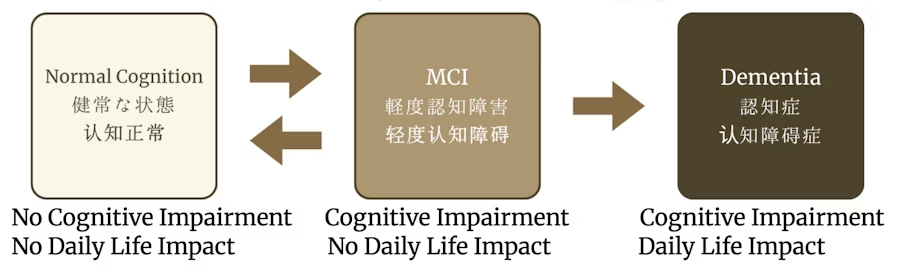
※1
Mild Cognitive Impairment Definition: Diagnostic Criteria
According to the internationally accepted Petersen criteria — the standard definition used worldwide — MCI is characterized by the following conditions ※2
Diagnostic Criteria for Mild Cognitive Impairment:
- Cognitive concern: You or a family member notice a decline in memory or thinking skills.
- Objective impairment: Clinical tests show cognitive decline greater than expected for your age, but not severe enough for a dementia diagnosis.
- Independent daily living: You maintain your independence and can perform basic activities of daily living (ADLs), though complex tasks may take more effort.
In essence, MCI represents a state where "formal dementia diagnosis has not yet been made, but concerning early symptoms are already present." Individuals who are more sensitive to subtle changes in themselves or loved ones tend to recognize these early warning signs sooner.
The 4 Main Types of Mild Cognitive Impairment
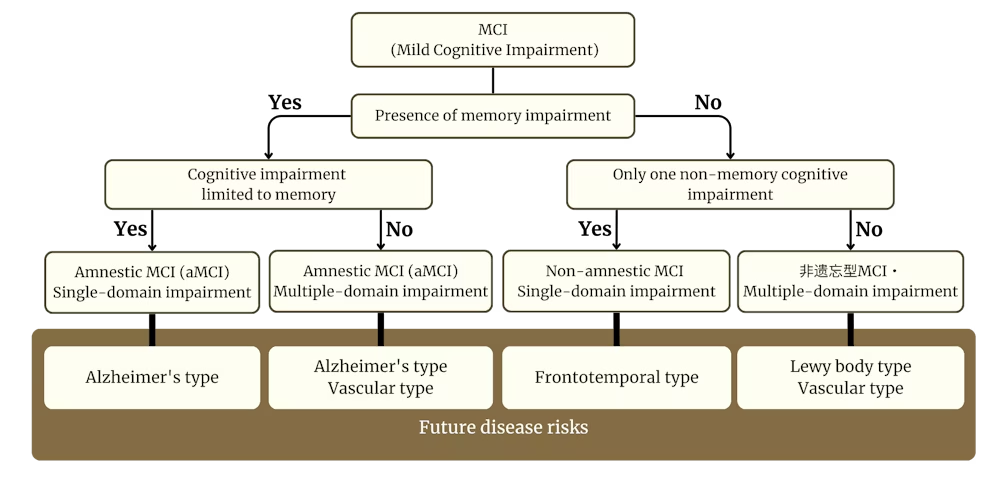
MCI can be classified into four distinct subtypes ※3:
Amnestic MCI (Memory-Related):
- Single-Domain: Memory impairment only
- Multiple-Domain: Memory impairment plus decline in other cognitive functions
Non-Amnestic MCI (Non-Memory Related):
- Single-Domain: Impairment in one non-memory function
Example: Language difficulties such as word-finding problems - Multiple-Domain: Impairment across multiple non-memory functions
Example: Language impairment combined with visuospatial cognitive difficulties
How Fast Does MCI Progress? Characteristics and Future Cognitive Changes
Several underlying diseases can lead to dementia, with Alzheimer's disease being the most representative. In Alzheimer's-type dementia, the earliest and most prominent symptom is typically forgetfulness, followed by word-finding difficulties and executive dysfunction. Memory problems appear first because brain regions responsible for memory — particularly the temporal lobe including the hippocampus — are affected earliest.
Dementia symptoms vary depending on both the underlying cause and which brain regions are affected first. Linking this to MCI subtypes:
- Amnestic Single-Domain: High risk for Alzheimer's disease.
- Amnestic Multiple-Domain: Linked to Alzheimer's or vascular dementia.
- Non-Amnestic Single-Domain: Potential precursor to frontotemporal dementia.
- Non-Amnestic Multiple-Domain: Associated with Lewy body or vascular dementia.
Regardless of whether MCI is amnestic or non-amnestic, when cognitive decline spans multiple domains, vascular dementia becomes more likely. Although MCI represents a relatively mild condition, simultaneous decline across multiple brain functions strongly suggests underlying cerebrovascular abnormalities, even when subtle ※4,5.
Can MCI Improve? Clinical Data on Recovery Potential
Research indicates the following facts ※1:
- Progression to dementia within 1 year: 5–15%
- Return to normal cognitive function within 1 year: 16–41%
- No significant change within 1 year: Remaining patients
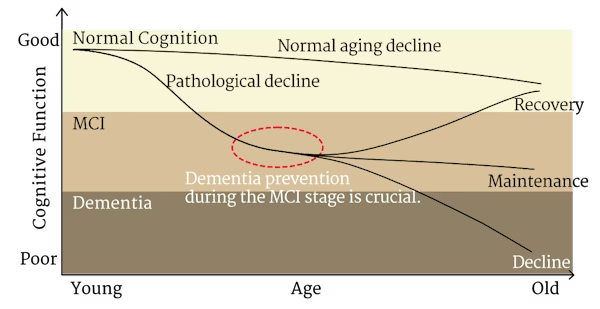
These findings suggest that early recognition of symptoms combined with evidence-based intervention can potentially slow disease progression and, in many cases, achieve meaningful cognitive improvement.
Common Symptoms of Mild Cognitive Impairment
"I've been getting more forgetful lately." "The words are on the tip of my tongue but won't come." "I can't remember names of people I know well."
Do these experiences sound familiar? Below are two typical cases illustrating how MCI symptoms manifest in daily life:
Case A: Male, 60s, Re-employed Part-time After Retirement

Symptoms:
・Tasks once handled efficiently now feel overwhelming and take significantly longer
・Cannot remember a 5-item shopping list without written notes or calling family members for confirmation.
Analysis:
Clear reduction in working memory capacity with patient awareness causing anxiety. This decline in executive function and short-term memory represents typical early symptoms that may precede dementia.
Case B: Female, 70s, Homemaker

Symptoms:
・Frequently forgets names of infrequent contacts, referring to them descriptively ("the person living next to the bakery")
・While cooking, often leaves pots unattended on stove or allows dishes to accumulate, disrupting meal preparation
Analysis:
Patient tends to dismiss changes as "just getting older," but family members notice abnormalities. Distinguishing age-related normal forgetfulness from MCI requires professional cognitive testing for objective assessment, preventing oversight of early warning signs.
Summary and Next Steps
As these cases show, people with MCI can still manage their daily lives, making it difficult for them to recognize that these changes may be early warning signs of dementia. Therefore, getting a professional medical test to catch these warning signs early is the first step to prevent further decline. If you or a family member notice any early symptoms, please consult a specialized medical clinic as soon as possible.
Author: Mie Koyama
Speech-Language-Hearing Therapist (ST)
Formerly conducted psychological assessment and cognitive testing at the Memory Clinic of the National Center of Neurology and Psychiatry, Musashi Hospital. Subsequently engaged in comprehensive speech and hearing rehabilitation across multiple settings including Prefectural University of Hiroshima, Yokohama City Stroke and Neurological Spine Center, and various geriatric care facilities.
Resources:
※1 National Center for Geriatrics and Gerontology. MCI Handbook, 2nd ed. 2020.
※2 Asada T. Cogn Neurosci. 2009;11.
※3 Dementia Net.
※4 Hanyu H. J Jpn Soc Intern Med. 2011;100:2109–2115.
※5 Hashimoto M, Ikeda M. J Jpn Soc Intern Med. 2011;100:2099–2108.