What is PRP Treatment?
PRP Treatment Programs at Tokyo Relife Clinic
Major Growth Factors Contained in Platelet-Rich Plasma
How PRP Works
Comparing PRP with Other Regenerative Medicine Treatments
PRP Treatment Duration & Treatment Cycle
Procedure Guide: PRP Treatment
Important Precautions for PRP Treatment
PRICE
Frequently Asked Questions (FAQ)
What is PRP Treatment?
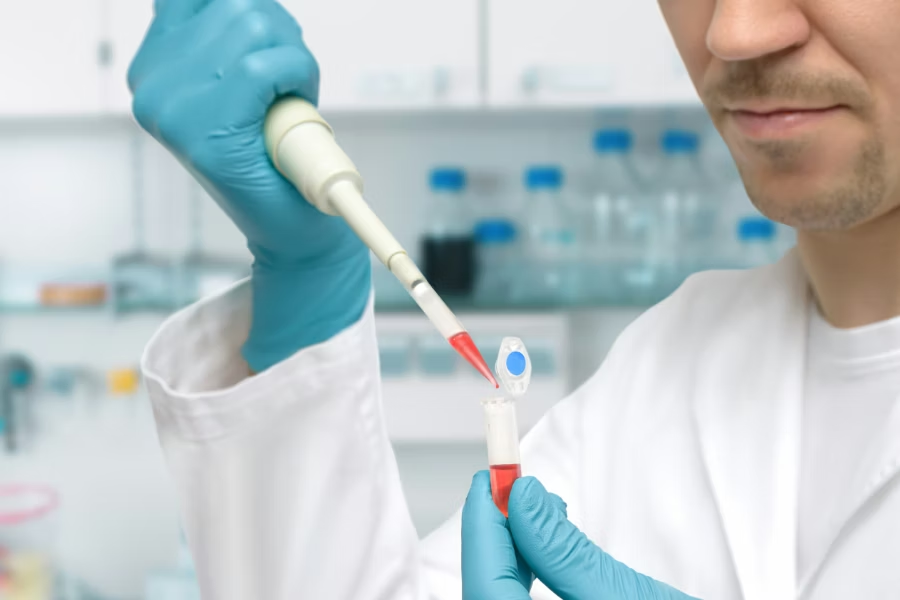
PRP (Platelet-Rich Plasma) is a concentrated preparation of platelets derived from the patient's own blood.
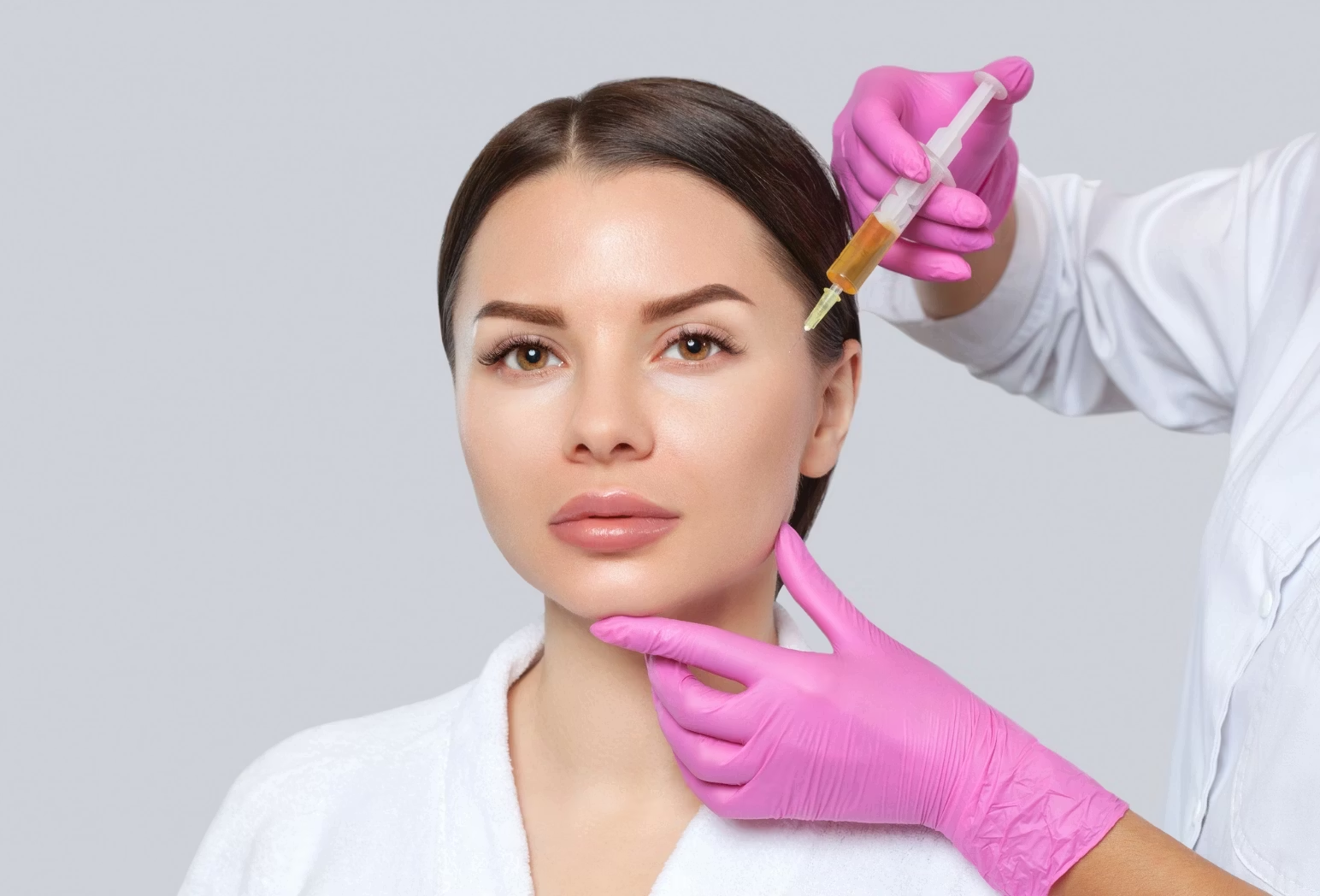
PRP treatment is a type of regenerative medicine that involves extracting platelet-rich plasma from the patient's own blood and precisely administering it to the target area through injection. This autologous treatment harnesses the body's natural healing mechanisms to support tissue repair and regeneration.
Key Characteristics of PRP:
- Advanced Tissue Repair Support
PRP is understood to actively support the body's natural tissue repair processes and help regulate the local inflammatory environment, promoting optimal healing conditions. - Concentrated Growth Factor Delivery
PRP contains a rich concentration of bioactive growth factors and proteins that play essential roles in cellular regeneration, tissue remodeling, and the body's natural recovery mechanisms. - Autologous Treatment Safety
Because PRP utilizes the patient's own blood (autologous treatment), the risk of allergic reactions or immune rejection is significantly minimized compared to foreign substance treatments.
PRP Treatment Programs at Tokyo Relife Clinic
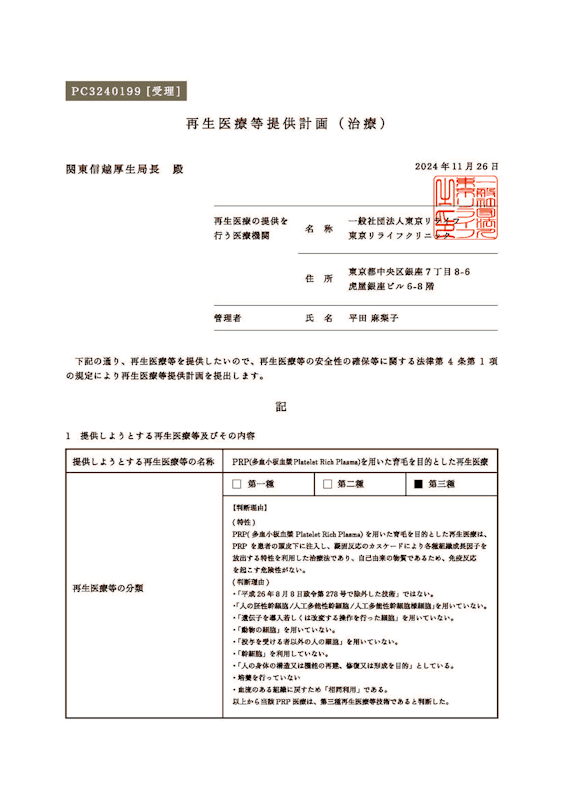
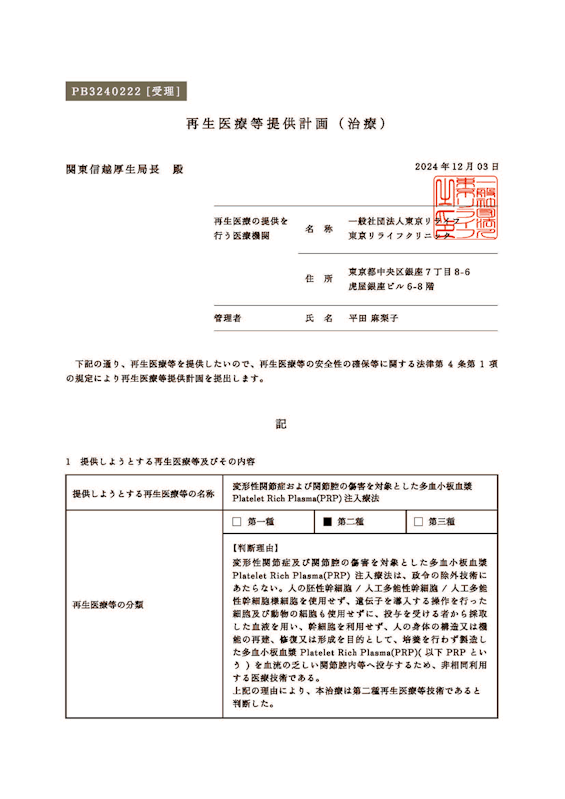
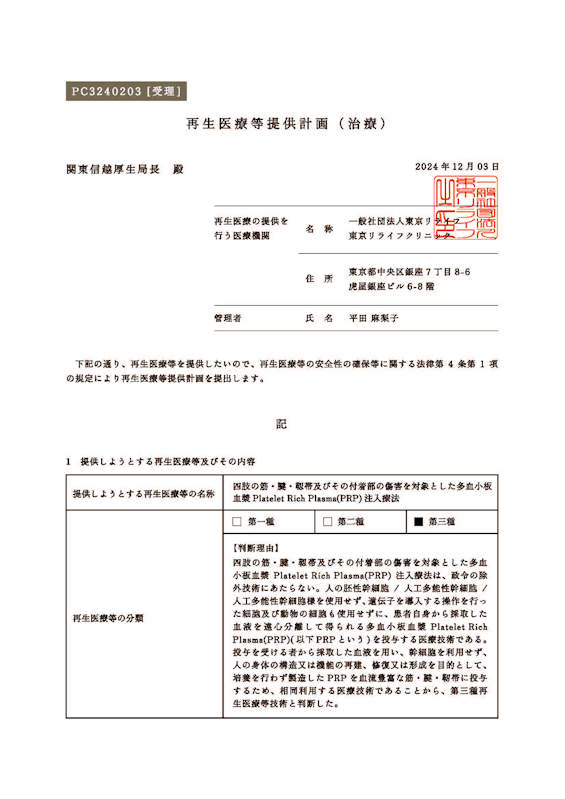
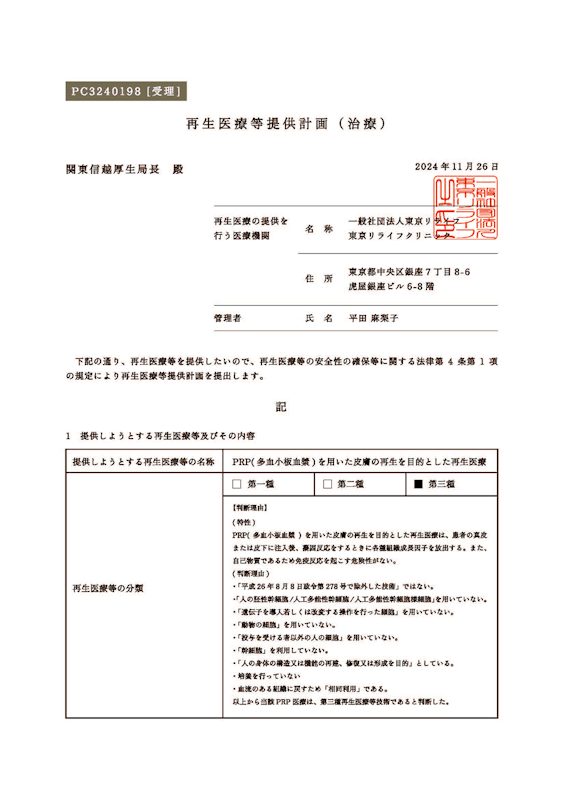
Tokyo Relife Clinic operates in full compliance with Japan's Act on the Safety of Regenerative Medicine. We have received official acceptance from the Ministry of Health, Labour and Welfare to legally provide the following PRP treatment programs.
All PRP treatments at our clinic are conducted strictly in accordance with officially accepted Regenerative Medicine Treatment Plans.
Accepted PRP Treatment Plans:
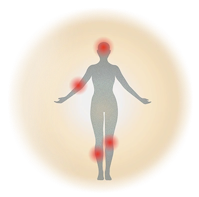
・PC3240199: PRP treatment for hair regeneration
・PB3240222: PRP injection treatment for osteoarthritis and intra-articular injuries
・PC3240203: PRP injection treatment for limb muscle, tendon, and ligament injuries
・PC3240198: PRP treatment for skin regeneration
Major Growth Factors Contained in Platelet-Rich Plasma
Growth Factor | Primary Functions |
|---|---|
PDGF | Guides tissue repair and regeneration. Promotes angiogenesis and supports new blood vessel formation. Enhances cellular proliferation and healing processes. |
TGF-β | Helps control inflammation. Modulates inflammatory responses and manages fibrosis. Supports comprehensive tissue repair mechanisms. |
VEGF | Stimulates angiogenesis. Promotes new blood vessel formation and enhances local blood flow circulation. |
FGF | Acts as a collagen production enhancer. Supports fibroblast proliferation and facilitates tissue repair. |
EGF | Supports epidermal repair processes. Promotes epithelial tissue regeneration and healing. |
*1, 2
These represent general characteristics of these components and do not guarantee specific therapeutic outcomes.
How PRP Works
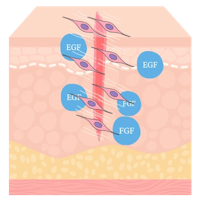
PRP treatment utilizes the wound healing mechanisms driven by platelet-derived growth factors (particularly PDGF). For this reason, it is considered to have excellent synergy with mesotherapy, which creates microscopic injuries in the dermal layer.
When mesotherapy creates countless micro-injuries in the dermis, the body recognizes this as "trauma" and initiates the natural wound healing response. PDGF contained in PRP is understood to play a central role in this process.
The Healing Process:
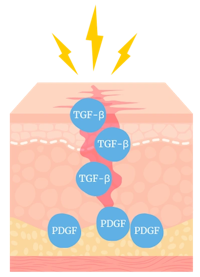
Step 1:
PDGF and TGF-β participate in the initial repair phase of wound healing, playing key roles in inflammatory response and tissue repair.
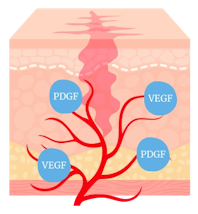
Step 2:
PDGF and VEGF stimulate angiogenesis, causing new capillaries to gradually grow into the treated area.
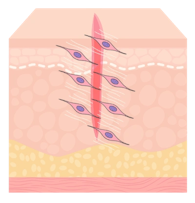
Step 3:
Migration of fibroblasts is promoted.
Step 4:
Subsequently, FGF and EGF contained in the PRP support fibroblast function, advancing wound healing through the production of collagen.*3
Understanding PRP's Natural Limitations
Because PRP treatment essentially relies on the body's natural wound-healing ability, it may be difficult for PRP alone to fully achieve the desired results in certain conditions such as chronic joint, tendon, or ligament injuries, or long-term hair loss.
※For these types of concerns, based on a comprehensive physician consultation and individual patient assessment, we may recommend more suitable treatment options, such as stem cell therapy, exosome therapy, or stem cell culture supernatant therapy.
Comparing PRP with Other Regenerative Medicine Treatments
Platelet-Rich Plasma (PRP), stem cell therapy, and exosome therapy are all prominent treatment approaches in the regenerative medicine field. However, each therapy has distinct roles and functions.
Feature | PRP Treatment | ||
|---|---|---|---|
Key Components | Platelet-derived growth factors | Living stem cells | Signaling molecules secreted by stem cells |
Mechanism of Action | Initiates early-stage wound healing response | Supports tissue reconstruction and regeneration | Regulates repair processes through intercellular communication |
Duration of Effects | Several weeks to 3 months | 1 year or longer | Several months to 1 year |
Target Conditions | Acute injuries, post-surgical recovery, early-stage conditions | Anti-aging, tissue defects, chronic diseases | Anti-aging, chronic inflammation, functional decline |
PRP Treatment Duration & Treatment Cycle
Following PRP treatment, some patients begin to notice changes within approximately 1 week to 1 month. However, the degree of response and duration of effects vary significantly among individuals.
To achieve more stable and sustained results, we typically recommend an initial series of 2 to 3 treatments at shorter intervals, followed by maintenance sessions approximately every 3 months.
Specific treatment intervals and the number of sessions will be determined through comprehensive physician consultation based on your individual condition and treatment goals.
Procedure Guide: PRP Treatment
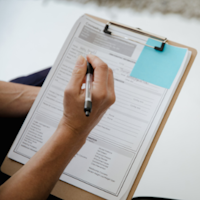
1. Medical Questionnaire & Consultation (Approximately 20 minutes)
First, you will complete a medical questionnaire to confirm your current health status, medical history, and any allergies. Our nurse will then discuss your specific needs and treatment goals in detail.

2. Physician Examination & Consent Form (Approximately 30 minutes)
The physician will conduct an examination and explain the scope of PRP treatment and the day's schedule. After reviewing the treatment plan and addressing any questions, you will be asked to sign the consent form.
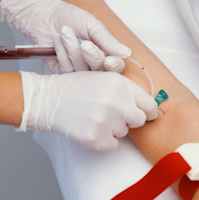
3. Blood Collection (Approximately 5 minutes)
Blood will be collected specifically for PRP preparation.

4. Payment Processing (Approximately 5 minutes)
We will complete the payment procedures.
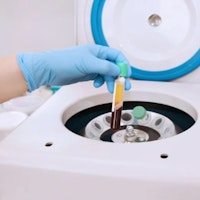
5. PRP Preparation via Centrifugation (Approximately 5 minutes)
The collected blood is processed through centrifugation to extract and concentrate the platelet-rich plasma.
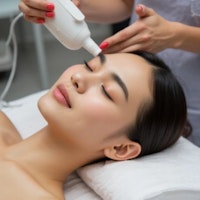
6. PRP Injection (Approximately 30 minutes)
The prepared PRP is precisely administered to the target area. Depending on your treatment goals, this may be combined with mesotherapy techniques for enhanced delivery.
Important Precautions for PRP Treatment
Who May Not Be Suitable for PRP Treatment
PRP treatment may not be appropriate for those who:
- Have active local infections or keloid-prone skin conditions
- Have received injections in the same treatment area within the past month
- Have previously received non-hyaluronic acid fillers or metal implants in the target area
- Have a history of allergic reactions to hyaluronic acid or other fillers
- Are pregnant
- Have been diagnosed with or are suspected of having malignant tumors
- Have unstable general medical conditions
- Have blood disorders or liver dysfunction
- Are currently taking anticoagulant medications (blood thinners)
- Are deemed unsuitable for this treatment by the treating physician after comprehensive evaluation
Depending on your specific condition or treatment area (e.g., knees, skin), additional contraindications may apply. Final suitability for treatment will be determined by your physician during consultation.
Post-Procedure Care
- Bathing & Face Washing: You may shower and wash your face on the day of treatment.
- Makeup: Please avoid applying makeup to the injection area only on the day of treatment.
- Daily Activities: On the day of injection, please avoid strenuous exercise, saunas, hot baths, and alcohol consumption.
- Care of Treated Area: Keep the injection site clean after the procedure. If prescribed topical or oral medications, please use them exactly as directed by your physician.
- Potential Side Effects: Symptoms such as redness or subcutaneous bleeding (bruising) may occur after injection. These typically resolve naturally within a few days to approximately one week. In rare cases where scarring occurs, resolution may take longer.
Depending on your specific condition or treatment area, additional precautions may apply. Our nurse will provide detailed instructions after your procedure; please follow them carefully.
PRICE
Hair Restoration, Osteoarthritis, Knee, Tendon & Ligament Treatment
【Mesotherapy(Face・Neck)】Skin Rejuvenation
Frequently Asked Questions (FAQ)
Q : Is the treatment painful?
A : Since the procedure involves manual injections or mesotherapy, you may experience multiple prickling sensations. Depending on the treatment area and method, anesthesia may be used to help minimize discomfort.
Q : How long does the PRP treatment take?
A : Depending on the specific program, the total time from arrival to completion is approximately 90 to 120 minutes. This duration may vary based on your desired treatment area and content.
Q : How long is the recovery period (downtime) for PRP treatment?
A : PRP treatment is generally considered to have a short recovery period. However, temporary symptoms such as redness, swelling, or subcutaneous bleeding (bruising) may occur, typically lasting from several days to approximately one week.
Q : Can I work or go out after treatment?
A : In most cases, you can resume normal daily activities immediately. However, on the day of treatment, please refrain from strenuous exercise, sauna use, hot baths, and alcohol consumption.
Q : Do I need to take time off work?
A : Generally, there is no need to take specific time off. However, depending on your treatment area and symptoms, your physician may provide individual instructions (such as recommending rest).
Q : How soon after treatment can I expect to notice results?
A : While individual responses vary, many patients begin to notice changes within approximately 1 week to 1 month following treatment.
Q : How long do the effects of PRP treatment last?
A : The effects of PRP treatment are generally understood to be relatively short-term, and the duration and post-treatment progress vary among individuals.
We typically recommend an initial series of 2 to 3 treatments at shorter intervals (e.g., every 2 weeks to 1 month), followed by maintenance sessions approximately every 3 months.
Q : How many treatment sessions will I need?
A : This depends on your treatment goals and individual condition, but multiple sessions may be required. A specific treatment plan will be determined by your physician following consultation.
Q : Are there any side effects or risks?
A : Because the treatment uses autologous blood (your own blood), the risk of allergic reactions is generally understood to be low. However, redness, swelling, subcutaneous bleeding (bruising), or pain associated with the injection may occur.
Q : Is PRP treatment suitable for everyone?
A : Not everyone is suitable for this treatment. Individuals with infectious diseases, those who are pregnant, or those with certain blood disorders may not be eligible. Final suitability will be determined by your physician during consultation.
References:
*1. Eppley BL, et al. Plast Reconstr Surg. 2004;114(6).
*2. Lee JW, et al. Arch Plast Surg. 2013;40(5).
*3. Eppley BL, et al. Plast Reconstr Surg. 2004;114(6).